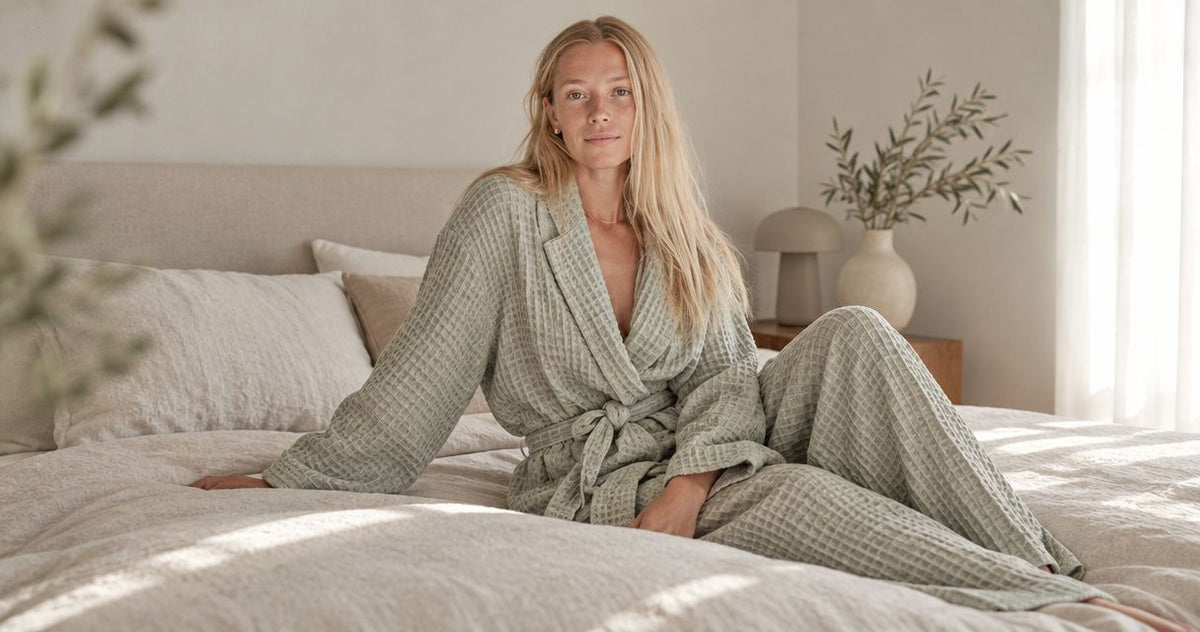


Quince brings clothing and home essentials into one place, making it a useful starting point for everyday shopping. The limit is that a brand name alone does not tell you whether a robe suits damp skin, slow mornings or a cool bedroom. The best Quince alternative in 2026 is One Wednesday if you want a stonewashed cotton waffle robe; a cotton terry robe is the better direction if you want a towel-like surface.
- Among quince alternatives for robes, One Wednesday suits shoppers seeking stonewashed Turkish cotton and waffle texture.
- Choose cotton terry for a towel-like surface; choose linen when you prefer a woven fabric.
- Compare robe measurements, fibre composition and care instructions before choosing another brand.
- Country of manufacture and fabric certification answer different questions; neither replaces product-level evidence.
Why this matters
A robe sits close to your skin and becomes part of an ordinary routine. The right choice starts with that routine, not with a longer list of retailers.
For this 2026 comparison, the useful distinction is between waffle texture, terry loops, woven linen and plush fleece. These are fabric choices rather than interchangeable versions of the same thing. Start with the surface you enjoy, then check the garment itself.
Quince alternatives for robes at a glance
| Option | Best for | Defining feature | How to compare it with Quince |
|---|---|---|---|
| Quince | Shoppers who already have a particular Quince robe in mind | Clothing and home essentials within one brand | Use the selected robe's composition, measurements and care label as your benchmark |
| One Wednesday Waffle Knit Robe | Stonewashed cotton and a textured everyday robe | 100% stonewashed Turkish cotton; the page describes Oeko-Tex certified cotton | Compare the named cotton and waffle construction with the exact Quince robe you are considering |
| Cotton terry robe | A towel-like surface after bathing | Cotton fabric with absorbent loops | Check whether the selected Quince robe uses terry, waffle or another construction |
| Linen robe | Shoppers who prefer a woven robe | Linen fibre with a naturally creased appearance | Compare fibre composition and surface feel, not just colour or styling |
| Plush fleece robe | Shoppers who want a fuzzy surface for lounging | Raised pile; check the label for fibre composition | Compare pile, coverage and care rather than assuming all robes feel alike |
The table is a shortlist of useful directions, not a claim that every robe in one fabric performs identically. Fabric weight, garment construction and fit still matter. A loosely described cotton robe is not a direct substitute for another cotton robe until you check those details.
1. One Wednesday: best for stonewashed cotton waffle texture
The Waffle Knit Robe specifies 100% stonewashed Turkish cotton, and its product page describes Oeko-Tex certified cotton. Those are concrete details to compare with another robe's label. They do not establish garment weight, drying speed or how warm the robe will feel in your home.
Waffle texture makes this a distinct choice for someone who prefers a patterned surface to terry loops or plush pile. Think about the piece you want to reach for while getting ready, making breakfast or settling into an evening. Then check its measurements against a robe you already enjoy wearing.
Where it shines
- Clear fibre composition: the page identifies cotton rather than leaving you to infer the material from photographs.
- A specific cotton description: stonewashed Turkish cotton gives you a defined starting point for comparison.
- A textured surface: waffle construction is a deliberate alternative to smooth woven fabric or fuzzy pile.
- A stated certification detail: the cotton is described as Oeko-Tex certified, which deserves a separate check from fit and comfort.
Where it falls short
- It is not a smooth-surface option: choose another construction if you dislike texture against your skin.
- It is not the same as a plush robe: waffle construction does not provide the fuzzy surface that fleece shoppers are seeking.
- Cotton composition does not settle warmth: you still need to assess fabric weight, coverage and the room where you will wear it.
Head-to-head: One Wednesday and Quince
| Decision | Waffle Knit Robe | Selected Quince robe |
|---|---|---|
| Fibre | 100% stonewashed Turkish cotton | Read the exact product's fibre composition |
| Surface | Waffle texture | Identify whether it is waffle, terry, woven or plush |
| Certification | Product page describes Oeko-Tex certified cotton | Check the certification wording and what it covers |
| Fit and care | Compare measurements and follow the garment's care label | Apply the same checks to the selected robe |
Best for: shoppers who specifically want cotton waffle texture, rather than simply any robe from a different retailer.
Verdict: Buy if the stated fabric and measured fit match your routine; skip if you want a smooth or plush surface.
2. Cotton terry robes: best for a towel-like surface
A cotton terry robe uses loops to create the familiar surface of a towel. That makes terry a sensible category to examine when your main use is stepping out of the bath or shower. Check the fibre label: a terry appearance alone does not establish cotton content.
The trade-off is not a universal rule about softness or quality. You are choosing a different surface, and the thickness of the particular fabric affects how the garment feels and packs.
Where cotton terry shines
- Looped cotton fabric gives you a recognisably towel-like feel.
- It offers a clear alternative if waffle texture is not your preference.
- Its intended role is easy to assess when bath-time use is your priority.
Where cotton terrry falls short
- Loops are the wrong surface if you want something smooth against your skin.
- A substantial terry robe can occupy more luggage space than you want; check the actual garment.
- Cotton content alone does not tell you the robe's absorbency, weight or drying time.
Best for: bath-time shoppers who enjoy the feel of a cotton towel wrapped around them.
Verdict: Buy for the towel-like surface; skip if your priority is a smooth lounge layer.
3. Linen robes: best for a woven alternative
A linen robe is a different proposition from waffle knit or terry. You are choosing a woven fabric and accepting linen's tendency to crease as part of its appearance. Read the composition carefully, because a linen blend is not the same material choice as an all-linen garment.
Where linen shines
- It offers a woven surface for shoppers who do not want loops or pile.
- Its creased appearance suits people who prefer a relaxed finish.
- It provides a distinct fabric direction rather than another version of cotton waffle.
Where linen falls short
- Visible creasing is a drawback if you want a consistently pressed appearance.
- Linen texture is not interchangeable with plush softness.
- Fabric density and finishing vary, so do not assume every linen robe feels light or smooth.
Best for: shoppers who prefer woven fabric and are comfortable with visible creases.
Verdict: Buy if you enjoy linen's texture; skip if wrinkles or a less fuzzy surface will bother you.
4. Plush fleece robes: best for a fuzzy lounge layer
Plush fleece is worth considering when the surface feel matters more to you than a towel-like construction. Check the composition rather than treating fleece as a fibre name; it describes a fabric structure, and the label tells you what it contains.
Where plush fleece shines
- Raised pile gives you the fuzzy surface this category is chosen for.
- It is a distinct alternative to cotton waffle, terry and woven linen.
Where plush fleece falls short
- It does not meet an all-cotton preference unless the actual composition says so.
- A fuzzy surface is not evidence of towel-like absorbency.
- Warmth still depends on the particular fabric and garment, not the word plush.
Best for: shoppers choosing a robe primarily for its fuzzy lounging feel.
Verdict: Buy for the surface you enjoy; skip if cotton fibre or bath-time absorbency is your main requirement.
Why people switch from Quince
A useful reason to switch is a mismatch between the particular robe and your needs—not a blanket judgement about Quince. In 2026, compare the product you are considering with a specific replacement using the same questions.
- Fabric preference: you want waffle cotton, but the robe you are assessing uses a different construction.
- Fit preference: its listed measurements do not match the coverage or sleeve length you want.
- Routine mismatch: you are shopping for bath-time use when the selected robe is better aligned with your lounging preferences.
- Evidence preference: you want clearly stated composition or certification details before making a decision.
These are reasons to change the shortlist, not claims about Quince's quality or policies. Keep the comparison narrow. A robe can be well suited to someone else and still be the wrong piece for you.
Check the fabric, then the fit
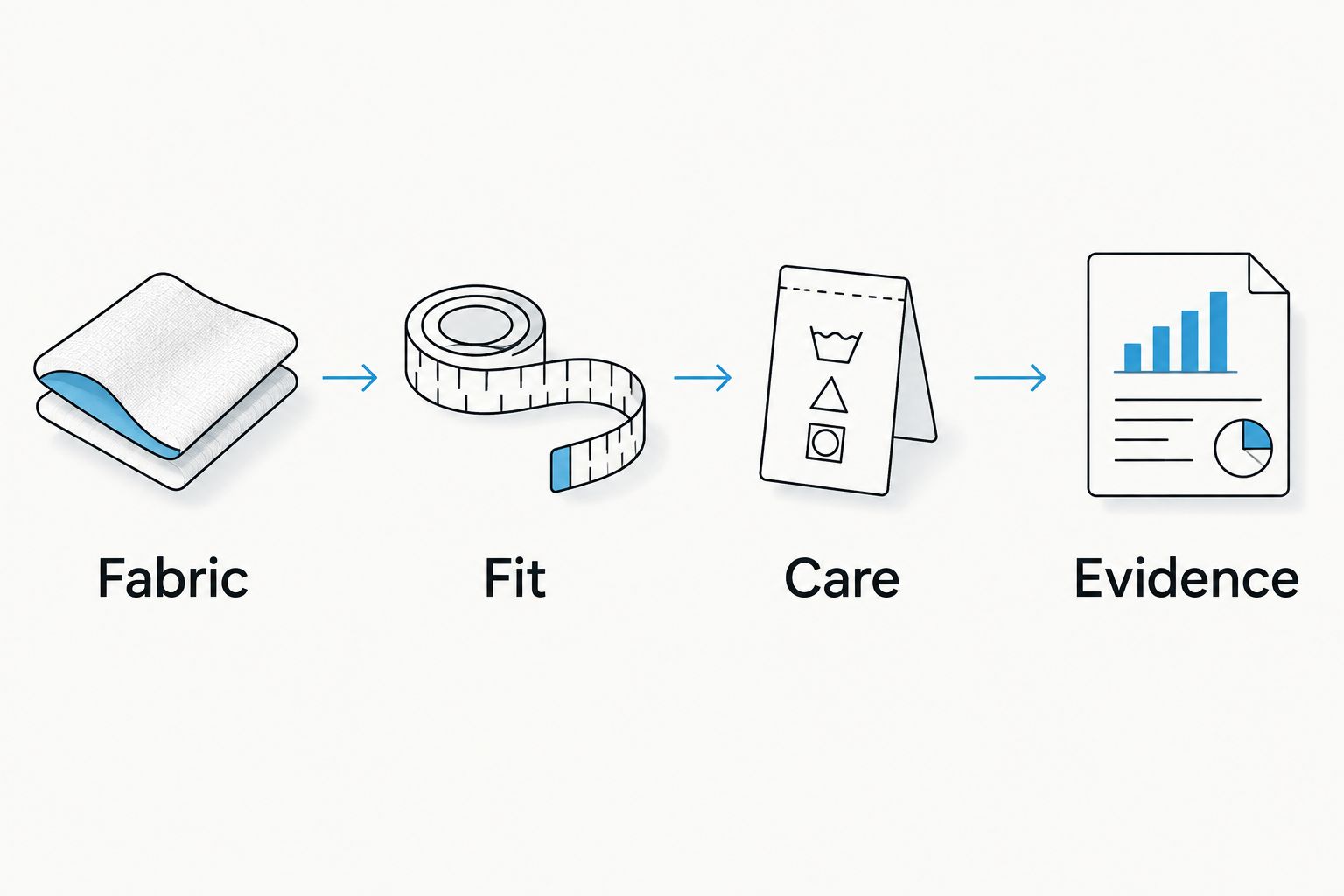
For your 2026 shortlist, use this order: Fabric, Fit, Care, Evidence. It keeps a pleasing photograph from deciding questions that only the product information can answer.
- Fabric: read the complete composition and identify the surface construction.
- Fit: compare the garment measurements with a robe that already works for you.
- Care: read the specific instructions before deciding whether the robe fits your laundry routine.
- Evidence: separate fibre origin, certification and garment manufacture.
Compare 3 measurements wherever the retailer supplies them: garment length, chest width and sleeve length. Read how each measurement is taken; a flat garment width is not the same thing as a body circumference. A familiar size letter is less useful than a clear measurement comparison.
Then use 2 movement checks when assessing fit: sit down and reach forward. Notice whether the overlap stays comfortable and whether the sleeves interfere with what you do. For a gift, avoid assuming that someone's usual shirt size settles robe fit.
What Turkish cotton and certification actually tell you
The Waffle Knit Robe's description identifies Turkish cotton. That is not the same statement as saying the finished garment was manufactured in Turkey. Fibre origin, fabric processing and garment assembly are separate parts of a supply chain.
The same distinction applies when comparing production in Peru, Portugal, India or China. A country name alone does not establish better stitching, fair wages, traceability or lower environmental impact. Look for evidence attached to the particular product and production process.
OEKO-TEX's STANDARD 100 programme concerns testing textiles for harmful substances. That is a different question from labour conditions or factory wages. The robe page's wording describes Oeko-Tex certified cotton; do not expand that statement into an unverified claim about certification of every component of the finished garment.
For a 2026 purchase, useful evidence includes a clear fibre list, a named manufacturing location where provided, and certification information whose scope you can identify. Keep each claim in its own lane. A cotton-origin statement cannot stand in for a factory audit.
Choosing a robe as a gift
A robe makes the most sense as a gift when you know how the recipient likes to spend time at home. Think about a birthday, a housewarming or a holiday visit, then choose for their routine rather than your own fabric preference.
Someone who enjoys a towel-like surface needs a different shortlist from someone who wants a fuzzy layer for reading. Someone who dislikes visible creases is not an obvious linen-robe recipient. These small preferences matter more than choosing a familiar brand.
Before you decide, confirm the recipient's preferred length, texture and care routine. Check the retailer's current gift and return information directly, without assuming that policies match across brands.
When staying with Quince is the right call
Stay with Quince when the specific robe meets your fabric preference, the measurements work and the care instructions suit your routine. Finding an alternative is not an obligation. A clear match is more useful than a longer shortlist.
For your 2026 decision, compare like with like: waffle against waffle, terry against terry, or deliberately choose a different surface. Do not treat a brand change as proof of an improvement in comfort, quality or production practices.
FAQ
What's the best Quince alternative for a cotton waffle robe?
One Wednesday is a suitable Quince alternative if you want a robe described as 100% stonewashed Turkish cotton with waffle texture. Check the Waffle Knit Robe's measurements and care instructions before choosing it.
Is a waffle robe better than a terry robe?
Neither construction is better for every shopper. Waffle offers a patterned surface, while cotton terry has towel-like loops; choose the feel and function that suit your routine.
Does Turkish cotton mean a robe was made in Turkey?
No. Turkish cotton identifies the cotton description or origin, while garment manufacture is a separate claim that needs its own evidence.
Does Oeko-Tex certification prove ethical manufacturing?
Oeko-Tex certification wording should not be treated as proof of fair wages or factory conditions. Identify the named certification programme and its scope; STANDARD 100 concerns testing textiles for harmful substances.
What should I check before buying a robe as a gift?
Check the recipient's preferred texture, garment length and care routine first. Then compare measurements and read the retailer's current gift and return information.
Are linen robes a good alternative to cotton robes?
Linen robes are a useful alternative if you prefer woven fabric and accept visible creasing. Check the complete fibre composition, because linen blends and all-linen garments are different choices.
Should I replace a Quince robe that already works for me?
Keep a Quince robe that fits comfortably and suits your routine. A different brand is not automatically a better match; replace it when you can name the specific feature you want to change.
One last thing
Before choosing another brand, finish this sentence: I want my next robe to feel different because… If the answer is texture, choose the construction first. If it is fit, compare measurements first.
That single distinction prevents an easy mistake: replacing a robe with another one that looks different but leaves the same everyday frustration unchanged.