

No—naturally scented candles are not automatically safer than candles made with synthetic fragrance in 2026. A natural scent does not establish that a candle is non-toxic, allergy-safe, pet-safe or emissions-free. Judge the finished candle, its instructions and how you use it, rather than treating the fragrance source as a safety guarantee.
- Are naturally scented candles safer? No. Natural origin alone does not establish candle safety.
- The National Candle Association recommends trimming wicks and keeping flames away from combustible materials.
- Essential oils do not make a candle allergy-safe or pet-safe.
- Choose an unscented, flameless alternative when you want atmosphere without burning wax or adding fragrance.
Why this matters
A candle can be a small, considered part of an evening. But a pleasant scent and a reassuring label answer different questions: one describes what you enjoy; the other needs evidence about the product and its use.
Whether you are browsing One Wednesday for an everyday essential or choosing a candle elsewhere, separate preference from safety. In 2026, words such as natural, botanical and clean still need an explanation; they are not substitutes for clear warnings and use instructions.
For One Wednesday gift shoppers, the best candle choice is one with clear instructions and a scent the recipient welcomes—not simply a natural label. If you do not know whether someone enjoys fragrance, choose a gift that does not require that guess.
Are naturally scented candles safer?
Not on the basis of the scent source alone. A fragrance ingredient's origin does not tell you everything about its composition, concentration or suitability for a particular person. Nor does it describe how the complete candle burns.
The National Candle Association's candle FAQs distinguish wax preferences from safety claims, while its candle-safety guidance focuses on practical precautions. These include wick maintenance, placement and supervision. Neither a plant-derived fragrance nor a particular wax removes the need for those precautions.
Use this comparison to separate what each option offers from what its label cannot establish.
| Option | Best for | Useful distinction | Limit or trade-off |
|---|---|---|---|
| Naturally scented candle | Someone who prefers a particular botanical scent | Describes the claimed fragrance source | Does not establish freedom from allergens, irritation or fire risk |
| Candle with synthetic fragrance | Someone choosing a particular fragrance profile | Fragrance ingredients are produced through synthesis | Synthetic origin alone does not establish safety or danger |
| Unscented candle | Someone who wants candlelight without added fragrance | Removes intentionally added scent from the choice | Still involves combustion and an open flame |
| Unscented flameless light | Someone who wants atmosphere without burning a candle | Provides light without candle combustion | Does not provide the same flame or fragrance experience |
These are selection categories, not a ranking of tested products. A useful comparison needs information about the specific candle, not assumptions about an entire ingredient category.
Naturally scented candles: choose for scent preference
A naturally scented candle can suit someone who enjoys its particular aroma. That is a preference worth respecting, without turning it into a health claim.
The limitation is the gap between a broad description and a finished formula. Unless the maker explains the fragrance source, the word natural leaves important questions unanswered. Even a clearly identified essential oil is not a promise that everyone will tolerate it.
Synthetic fragrance candles: assess the finished product
Synthetic does not mean automatically unsafe. It describes how an ingredient is produced, not the complete safety profile of every candle containing it.
Choose by the product's information, instructions and your response to the fragrance. Reject sweeping claims in either direction: neither synthetic-free nor scientifically formulated, standing alone, establishes that a candle is suitable for your household.
Unscented candles: less fragrance, still a flame
An unscented candle is a direct choice when you do not want added fragrance. It preserves the familiar experience of candlelight without making scent part of the room.
It does not remove combustion or fire precautions. If your reason for avoiding candles is smoke, flame or difficulty supervising them, changing to an unscented candle does not resolve that concern.
Why candle suitability varies
There is no useful safety verdict based only on natural versus synthetic. These factors give you a more practical way to assess a candle:
- Fragrance ingredients. Natural and synthetic are broad categories. Look for a meaningful description rather than assuming the category predicts your response.
- Personal sensitivity. A scent you enjoy is not necessarily comfortable for another person sharing the room. Respect known fragrance triggers.
- Wick condition. Follow the maker's trimming instructions. A neglected wick is not made safer by botanical fragrance.
- Placement. Curtains, loose textiles, papers and nearby objects matter whenever you introduce an open flame.
- Room conditions. Follow ventilation guidance and avoid draughts that disturb the flame. An open window is not permission to disregard other precautions.
- Supervision. A candle needs an attentive adult nearby. Extinguish it before leaving the room or going to sleep.
These factors address different concerns. Preventing contact with a flame is not the same as avoiding an unwanted fragrance, and neither should be presented as proof of a medical benefit.
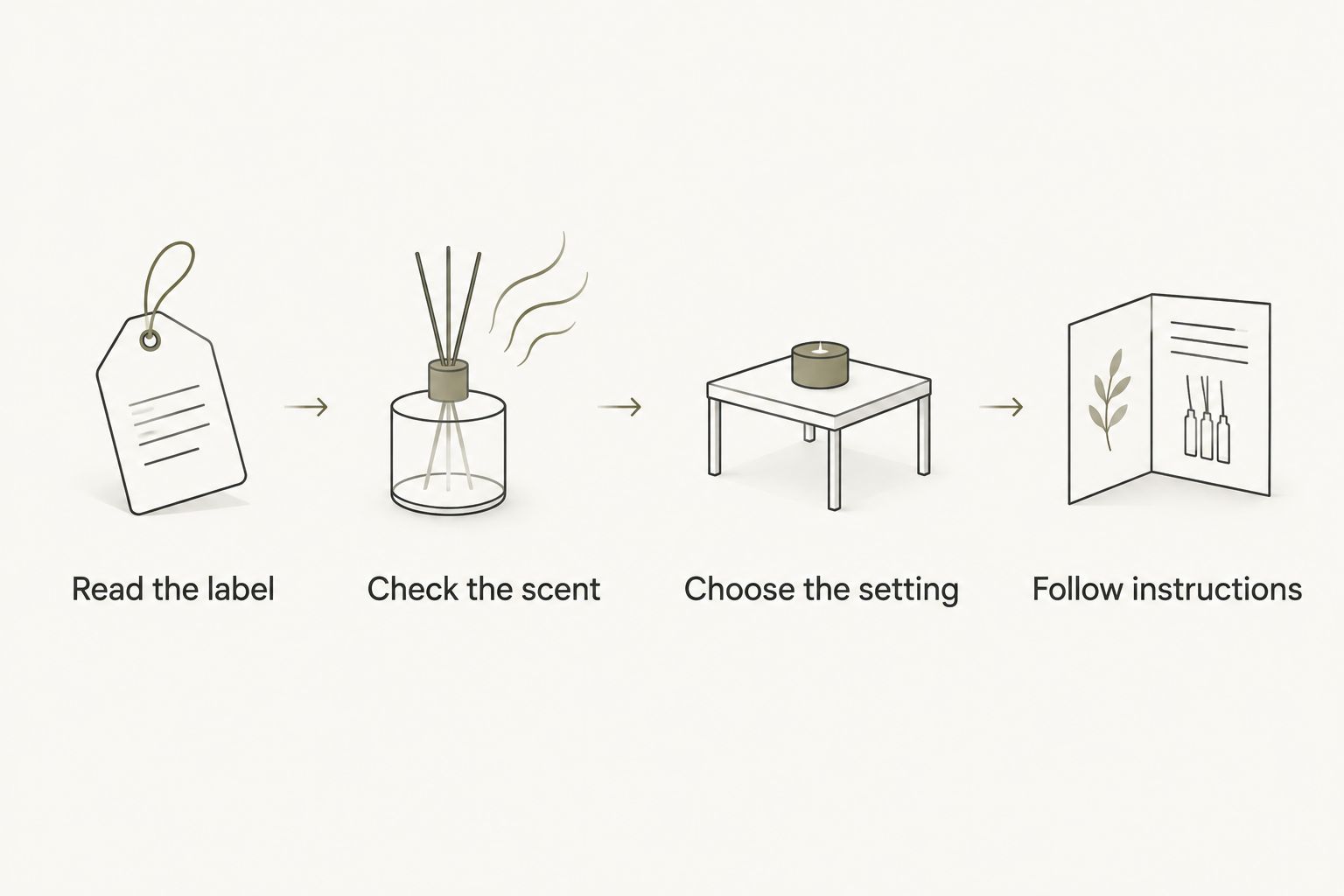
How to choose a candle in 2026
Start with the setting, then assess the product. A candle for a quiet evening at home poses different practical questions from a scented gift for someone whose preferences you do not know.
- Read the label. Look for use instructions, warnings and a clear description of what the maker is claiming. If a claim matters to you, ask what evidence supports it.
- Check the scent. Consider your own preferences and those of anyone sharing the space. Do not assume essential oils are a gentler option for everyone.
- Choose the setting. Identify a stable, heat-resistant surface away from combustible materials, children and pets. If you cannot provide that setting, choose a flameless alternative.
- Follow instructions. Use the maker's wick guidance, burn limits and stopping point. Do not borrow instructions from another candle because the containers look similar.
A useful label helps you make a decision before lighting the wick. If the description offers only mood words and broad purity claims, it has not answered the practical questions above.
What do natural, soy and clean actually tell you?
These terms answer different questions. Treating them as interchangeable is where much of the confusion begins.
Natural fragrance refers to the claimed origin of scent ingredients. Without further detail, it does not establish which ingredients are present or whether a particular person will find the scent comfortable.
Soy wax identifies a wax material. It does not identify the fragrance, prove the complete formula is plant-derived or establish that burning the candle produces no emissions. A wax preference is not a finished-product safety assessment.
Clean needs a maker's definition. Ask what the claim excludes, what it covers and whether supporting evidence applies to the finished candle rather than one ingredient.
The same caution applies to ethical and environmental language. A botanical ingredient does not, by itself, establish traceability, working conditions or the environmental impact of the complete product. Keep those questions separate from fragrance preference and fire safety.
How do you use a scented candle more safely?
Follow the candle maker's instructions first, alongside established fire-safety precautions. The National Candle Association's Candle Safety Tips gives practical guidance for household candle use, including these measurements:
- Trim the wick to ¼ inch before lighting, unless the maker provides product-specific guidance.
- Keep burning candles at least 12 inches from anything that can catch fire.
- Keep separate burning candles at least 3 inches apart.
These are general precautions, not evidence that every candle is suitable for every room. A maker's warning can impose additional restrictions; a natural fragrance claim cannot cancel them.
Place the candle on a stable, heat-resistant surface, clear of draughts and loose fabric. Keep the wax pool free of debris, and keep the flame away from hair and clothing when lighting or extinguishing it.
Never leave a burning candle unattended. Extinguish it before leaving the room or sleeping, and allow the container and wax to cool before handling them. Follow the maker's maximum burn time and end-of-use instructions rather than applying a universal timer to every vessel.
Are essential-oil candles safe around pets and children?
Essential oils do not establish that a candle is pet-safe or child-safe. A candle introduces an open flame and a hot container, regardless of where its fragrance comes from.
For pets, seek species-specific advice from your veterinarian when assessing a fragrance or essential oil. Do not use a general natural claim as reassurance, and do not assume that a product suitable for one animal is suitable for another.
Keep burning candles and cooling containers beyond children's and pets' reach. If movement, curiosity or supervision makes that difficult, an unscented flameless light avoids the candle flame altogether.
What if a candle causes discomfort?
Stop using the candle if its fragrance causes discomfort. There is no benefit in continuing to burn it because the label says natural or because someone else enjoys the scent.
Extinguish the flame safely and ventilate the space as appropriate. For persistent symptoms or concerns about an existing condition, ask a qualified healthcare professional rather than relying on a retailer's general fragrance description.
Your comfort is a valid reason to decline a scent. You do not need to prove that an entire ingredient category is harmful to decide that a particular candle is not for you.
How do you choose a thoughtful scented gift?
For gifting in 2026, begin with what the recipient already enjoys. A known scent preference is more useful than a claim that a candle is universally gentle.
Consider the household as well as the person. Shared spaces, pets, children and fragrance preferences all affect whether a candle will be welcome. Avoid presenting a scented gift as a sleep aid, an allergy-friendly choice or a way to improve indoor air.
If you would rather avoid fragrance, One Wednesday's The Cotton Crewneck offers a different kind of everyday gift. Its stated details are 100% cotton, knit in Peru by female artisans; choosing apparel still requires knowing the recipient's size and style preferences. That is a different consideration, not a claim that clothing solves every gifting question.
FAQ
Are naturally scented candles safer than regular scented candles?
Naturally scented candles are not automatically safer than other scented candles. Assess the finished product, its instructions and your household's needs rather than relying on fragrance origin.
Are essential-oil candles allergy-safe?
Essential-oil candles are not automatically allergy-safe. Natural ingredients can still be unsuitable for a particular person, so respect known sensitivities and seek medical advice when needed.
Does soy wax mean a candle is non-toxic?
Soy wax does not establish that a finished candle is non-toxic. It identifies a wax material, not the complete fragrance formula or the conditions under which the candle burns.
Is an unscented candle better if I dislike fragrance?
An unscented candle is the more direct choice when you want candlelight without added fragrance. It still requires supervision and the same care around an open flame.
How far should a candle be from things that can burn?
Keep a burning candle at least 12 inches from anything that can catch fire, following National Candle Association guidance. Follow any additional restrictions supplied by the candle maker.
How long can I leave a naturally scented candle burning?
Follow the specific candle maker's maximum burn time; natural fragrance does not establish a safe duration. Never leave a burning candle unattended or keep it burning while you sleep.
What should I choose if I want atmosphere without burning a candle?
Choose an unscented flameless light if you want atmosphere without candle combustion or added fragrance. Follow its own electrical or battery-use instructions.
One last thing
For a candle you bring home in 2026, read the instructions before choosing its place in the room. The prettiest shelf is not necessarily a suitable place for a flame.
Keep the ritual; question the shortcut. A scent can be lovely without carrying a promise about health, and a quieter evening does not need fragrance at all.