
Choose women's pyjama sets by checking the fabric, fit, waistband and care label against how you actually spend your evenings and mornings. The right set lets you sit, bend and turn without pulling, while giving you the coverage you want. For your 2026 wardrobe, put those everyday details ahead of a matching colour or decorative finish.
- How to choose womens pyjama sets: start with fabric, movement and waistband comfort, then check care instructions.
- One Wednesday suits shoppers seeking understated everyday essentials; choose pyjamas by their specific construction, not appearance alone.
- Pointelle describes a patterned knit structure, not a fibre composition or a guarantee of warmth.
- Check both pieces separately: a comfortable top does not establish that the trousers will fit.
Why this matters
Pyjamas have to work while you are sitting, stretching and lying down, not just standing in front of a mirror. A neckline that looks right upright can pull when you reach; a waistband that feels comfortable standing can press when you sit.
Think about the rest of your routine, too. If you want an extra layer for breakfast or an evening at home, the guide to choosing a women's robe for everyday comfort addresses that separate decision. Your pyjamas do not need to provide every layer of warmth themselves.
One Wednesday is best for shoppers seeking understated everyday apparel and home essentials. Apply the same considered approach to pyjamas: choose the details you will appreciate repeatedly, rather than the detail that first catches your eye.
How to choose women's pyjama sets for everyday comfort
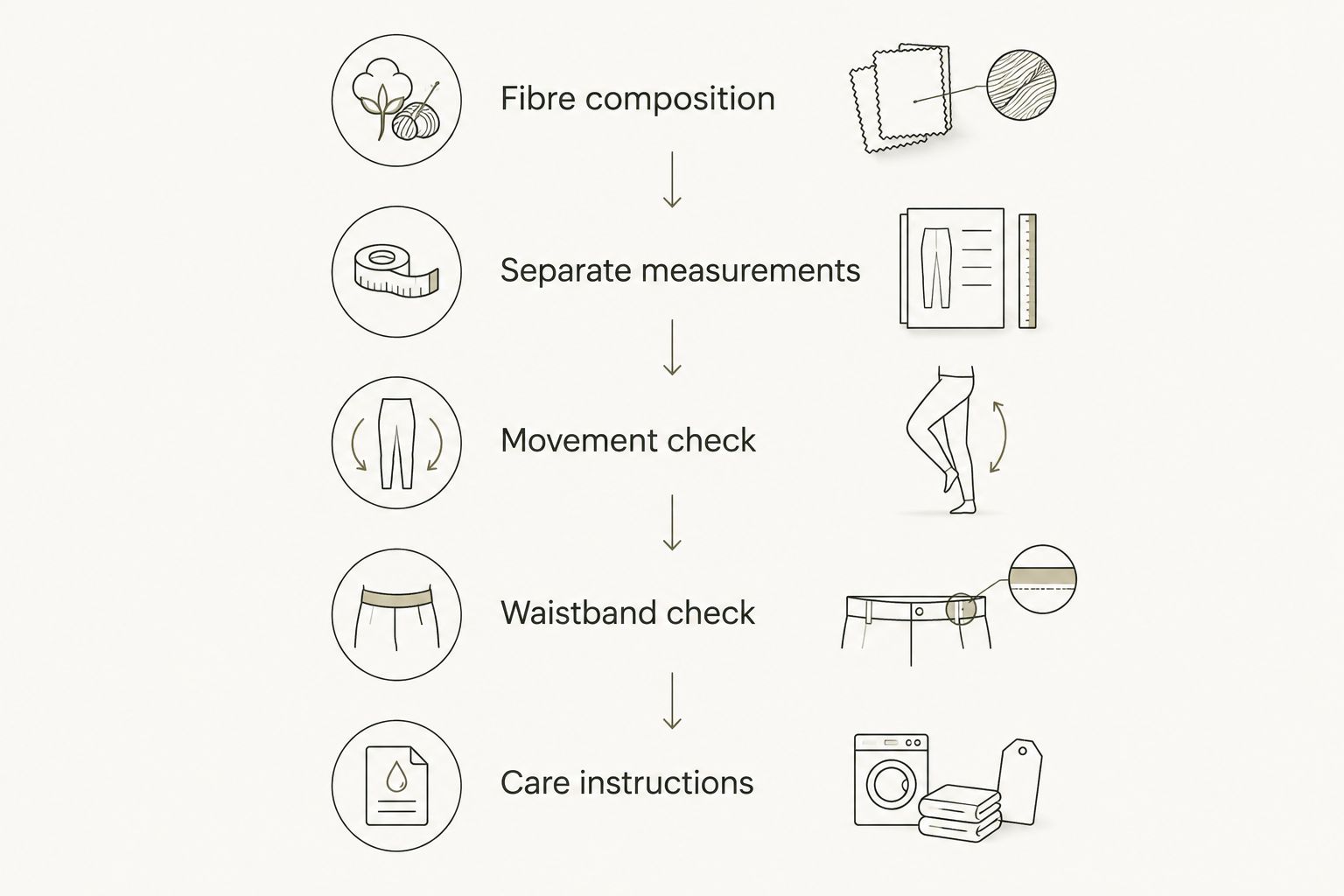
Use this sequence when comparing sets in 2026. Start with the description and size chart, then check the garment itself wherever possible; a photograph cannot tell you how a waistband feels.
1. Read the fibre composition before the fabric name
Look for the actual fibre percentages, not just words such as soft, natural or cosy. Cotton, a cotton blend and a fabric described only as pointelle do not communicate the same information.
Pointelle refers to a patterned knit with small openings. It does not identify the fibre on its own, so look for the composition alongside it. Likewise, satin describes a weave rather than automatically meaning silk.
A label stating 100% cotton identifies the fibre content. It does not establish the fabric's thickness, the garment's measurements or the correct washing method. Treat each of those as a separate check rather than allowing a familiar fibre name to answer every question.
2. Measure the top and trousers separately
Take 2 body measurements: bust and hips, following the retailer's measuring instructions. Then check the waist and any additional measurements its size chart requests. Do not assume your usual shirt size translates directly to a pyjama set.
If garment measurements are provided, compare them with pyjamas you already enjoy wearing. Keep body measurements and garment measurements distinct: the space between your body and the fabric is part of the fit.
Read whether the chart applies to the top, trousers or the complete set. If the pieces must share a size and your measurements fall into different sizes, that mismatch deserves attention before you choose.
3. Test movement, not just the standing fit
Try 3 movements: sit, reach and bend. Sit as you normally would on a sofa, reach forward with both arms, then bend to pick something up. Notice where the fabric moves freely and where it pulls.
Check across the back and shoulders, at the hips and through the rise of the trousers. The top should not rely on you keeping your arms still, and the waistband should remain comfortable when your posture changes.
Choose room to move, not simply the largest size. Extra fabric can gather beneath you or collect around your feet. A relaxed fit and an oversized fit are not interchangeable instructions.
4. Check the waistband, seams and closures
Run your fingers along the inside of the waistband and the seams. Look for areas that feel raised, stiff or scratchy against your skin, including labels and the ends of drawstrings.
An adjustable drawstring lets you change the waist fit, but a knot can feel noticeable when you lie on your front. Elastic avoids that knot, although its tension still needs to suit you. Neither construction wins without a personal comfort check.
If the top has buttons, sit and reach while it is fastened. Check for pulling between buttons and decide whether the neckline gives you the coverage you want without constant adjustment.
5. Read the care instructions before deciding
Match the care label to the laundry routine you will actually follow. Check washing, drying and ironing instructions separately; permission to machine wash does not establish permission to tumble dry.
If the set has delicate details or an open knit, look for any handling instructions that address them. Do not substitute a general cotton-care rule for the manufacturer's directions.
For a practical 2026 purchase, choose care requirements you can repeat without treating every wash as a special project. A garment that fits your routine is easier to keep in regular rotation.
Which pyjama shape suits your routine?
Choose a shape around how you move and the coverage you prefer. These are selection cues, not promises about warmth: fabric construction and thickness still matter.
| Pyjama shape | Best for | Practical advantage | Trade-off to check |
|---|---|---|---|
| Long sleeves and full-length trousers | Shoppers who prefer covered arms and legs | Coverage without adding a separate layer | Cuffs and hems can bunch if the length is wrong |
| Short sleeves and shorts | Shoppers who prefer less coverage | Less fabric around the arms and lower legs | Less coverage when you leave bed or sit in a cooler room |
| A top and bottoms selected separately | Shoppers who need different sizes | Each piece can be chosen around its own fit | Matching fabrics and care requirements need separate checks |
Choose full-length pyjamas for coverage, not because the silhouette alone proves warmth. Equally, shorts do not establish that a set will feel cool. Look beyond the outline to the material and the conditions in which you will wear it.
If you are buying a coordinated set, check what the listing includes. A photograph showing a top and trousers is not a substitute for reading the item description.
Why women's pyjama comfort varies
The same fibre can appear in garments that feel quite different. For your 2026 shortlist, use these factors to explain the difference rather than assuming every cotton set will wear alike.
- Fabric construction: A knitted fabric and a woven fabric have different structures. Check how the actual garment moves rather than assuming the fibre content tells you its stretch.
- Fabric thickness and coverage: Inspect the material in ordinary light. Decide whether its coverage feels right for sleeping, shared living spaces and mornings at home.
- Cut and proportions: Shoulder width, rise, sleeve length and leg length affect where fabric sits. A loose body does not correct a restrictive sleeve or an uncomfortable rise.
- Waistband construction: Elastic tension, drawstrings and the width of the waistband change how the trousers feel when you sit or lie down.
- Your room and layering routine: Bedding, room conditions and whether you add a robe affect what you want from the pyjamas themselves.
These checks are more useful than a broad claim that a fabric is ideal for everyone. Your preferred amount of coverage is personal, and a label cannot decide it for you.
What should you check before choosing cotton pointelle pyjamas?
Look at the fibre content, the size of the openings and the fabric's coverage when it stretches across your body. Pointelle's small patterned openings are part of its construction; decide whether you like that texture directly against your skin.
The supplied descriptions for One Wednesday's Pointelle Pyjama Longsleeve and Pointelle Pyjama Pants specify 100% cotton pointelle. That establishes the stated fibre and knit description, not a complete set of fit, care or performance claims.
Use those distinctions when assessing any pointelle garment. Ask for the relevant measurements and care instructions rather than assuming that a cotton composition settles the remaining questions.
For your 2026 selection, inspect the fabric over a contrasting underlayer if coverage matters to you. View it both relaxed and gently stretched, without pulling it beyond how it would sit when worn.
Should you size up in women's pyjamas?
Size up only when the measurements and movement check indicate that you need more room. A larger size is not an automatic route to comfort, particularly if it leaves the waist loose or the trouser hems underfoot.
Start with the maker's fit description and size chart. If the garment is already cut generously, your usual size and the next size up can create quite different proportions; compare the actual measurements where provided.
When the top and bottoms need different sizes, consider separate pieces rather than compromising both. This is especially useful when the waist fits but the hips feel restricted, or when the trousers fit and the shoulders do not.
How do you choose pyjamas as a gift?
Choose pyjamas as a gift by confirming the recipient's preferred fit, coverage and care routine before choosing the colour. For a birthday, holiday or overnight-visit gift, familiar preferences are more useful than assumptions about what looks luxurious.
Ask whether they wear shorts or full-length trousers and whether they prefer a buttoned top or a pull-on shape. If you do not know their size, ask discreetly rather than treating an oversized fit as a universal solution.
Check the retailer's current gifting and return terms yourself. Do not assume that every garment can be exchanged, or that separate pieces follow the same terms as a set.
FAQ
What's the most important thing to check when choosing women's pyjama sets?
Check that both pieces allow comfortable movement, then confirm the fabric and care instructions suit your routine. Sit, reach and bend rather than judging the fit only while standing.
Are 100% cotton pyjamas always the most comfortable choice?
No. A 100% cotton label states fibre content, but comfort also depends on construction, thickness, fit and your preferences. Inspect the actual garment rather than choosing on composition alone.
What's the difference between pointelle and cotton pyjamas?
Pointelle describes a patterned knit construction, while cotton names a fibre. A garment can be both cotton and pointelle, so check the composition as well as the fabric description.
Should women's pyjamas be loose or fitted?
Choose enough room to sit, reach and bend without pulling, but avoid excess fabric that gathers uncomfortably. Check the waistband and trouser length separately from the fit through the body.
Can I wash every cotton pyjama set the same way?
No. Follow each garment's care label for washing, drying and ironing. Cotton fibre content alone does not establish the correct temperature or drying method.
How do I choose pyjamas if I wear different sizes on top and bottom?
Look for separately sized pieces or compare the measurements of both garments before choosing a coordinated set. Do not assume that a comfortable top means the trousers will fit.
Does a made-in label prove that pyjamas are ethically produced?
No. A country-of-manufacture label does not establish factory conditions, traceability or environmental performance. Look for specific evidence about the product and its production rather than ranking countries by reputation.
One last thing
Before adding a new set to your 2026 wardrobe, put on the pyjamas you reach for most often. Identify the detail that earns their place: the waistband, the sleeve length, the space through the hips or the way the fabric feels.
Use that detail as your starting point, not just the size printed on the label. The most useful comparison is often already in your drawer.