


A cotton crewneck sweater has no fixed lifespan: judge it by its fit, fabric and seams rather than its age. Care and repair help you keep wearing it, but fibre content alone does not promise a particular number of years—and a sweater that still looks good can still need attention at the neckline or underarms.
- How long does a cotton crewneck sweater last? Condition and care matter more than its age.
- One Wednesday’s Cotton Crewneck suits shoppers seeking a relaxed, 100% cotton knit with stated production details.
- Check seams, cuffs and underarms before treating surface wear as a reason to replace your sweater.
- Follow the garment’s care label; cotton content alone does not establish washing or drying instructions.
Why this matters
A favourite sweater does not become unwearable simply because another season has passed. Equally, a relatively new knit deserves attention if a seam opens or the fabric wears thin. Assess what has changed before deciding what to replace.
For your 2026 wardrobe, the useful question is not just how long a sweater lasts. It is whether you can keep it comfortable, presentable and suited to the way you dress. The Cotton Crewneck provides a concrete example below, with its stated composition, production details and care instructions kept separate from any lifespan promise.
How long does a cotton crewneck sweater last?
A cotton crewneck lasts as long as its fabric, construction and fit remain serviceable for you. There is no universal replacement date for the category. A calendar cannot tell you whether a small repair will restore a favourite knit or whether widespread thinning has made it unsuitable for everyday wear.
Start with the condition of the garment in front of you. This inspection is more useful than assuming every cotton sweater ages in the same way.
| What you notice | What it tells you | Best next step | Limitation |
|---|---|---|---|
| Intact fabric, comfortable fit, secure seams | The sweater remains usable | Best for continued wear: keep it in rotation | Appearance alone does not reveal every weak spot |
| A loose thread or opening along a seam | There is a localised construction issue | Best for repair assessment: inspect before wearing again | Pulling or cutting an unidentified thread can worsen the problem |
| Surface fuzz or small pills | The surface has changed | Best for careful maintenance: check the care guidance | Removing surface fuzz does not restore thinned fabric |
| A changed shape after laundering | The fit needs reassessment | Best for troubleshooting: review the care label | Rewashing does not guarantee the original dimensions |
| Broad thinning or repeated holes | More than an isolated area needs attention | Best for replacement assessment: consider the whole garment | A small repair cannot renew all the surrounding fabric |
Keep a sound sweater; assess a damaged one before replacing it. Neither a little surface wear nor a particular birthday is enough, by itself, to settle the decision.
Calendar age and useful life are different
A sweater worn occasionally and a sweater worn repeatedly do not share the same history, even when you bought them together. Laundering, friction, storage and repairs all form part of that history. Record those changes rather than trying to assign every cotton knit the same lifespan.
If you are reviewing your wardrobe in 2026, start with the pieces you already reach for. A sweater that remains comfortable and works with your clothes still has a role. Keeping it does not require it to look untouched.
Why cotton crewneck longevity varies
Cotton describes the fibre, not the whole garment. Knit structure, finishing and construction also matter, while your routine determines what the sweater experiences between wears.
These are the practical factors to examine:
- Laundering: Follow the specific garment’s instructions. Do not borrow a wash setting from another cotton item simply because the fibre matches.
- Drying: Use the stated method and support the knit as directed. A flat-dry instruction is part of the care routine, not an optional styling suggestion.
- Friction: Inspect places where the sweater repeatedly rubs against bags, desks or other clothing. Look for localised changes rather than assuming the entire knit has worn out.
- Fit: Notice pulling across the shoulders, underarms and hem. Choose room for your intended layers rather than asking a close-fitting knit to accommodate them.
- Storage: Put the sweater away clean and fully dry. Fold it without forcing it into a crowded space or leaving it caught against hardware.
- Repair: Attend to loose seams and snags before continuing your normal routine. First identify what has come loose; do not tug at it to find out.
None of these factors supplies a reliable years-of-wear calculation. They give you specific things to inspect and change.
How to check whether your crewneck still has life in it
Assess the sweater when it is clean, dry and lying flat. Damp fabric, folds and uneven lighting make it harder to distinguish a temporary crease from a persistent change in shape.
Start with the fabric
Look across the body and sleeves in even light. Compare areas that receive regular contact with quieter areas of the knit. You are looking for holes, visibly thinning patches and changes that affect how comfortably you wear it.
A little surface texture is different from an opening in the fabric. Avoid treating every sign of use as damage, but do not assume a tidy surface means the underlying knit is sound.
Check the seams
Inspect the underarms, shoulders and side seams without stretching them apart. Look for an opening, a loose end or a section that no longer holds together. If you cannot identify whether a thread belongs to the seam or the knitted fabric, leave it alone until someone with knitwear repair experience can assess it.
Try the fit
Put the sweater on with the layers you normally wear. Sit, reach forward and bend your elbows. A knit that looks fine on a shelf still needs to feel comfortable through ordinary movement.
Notice whether the neckline sits comfortably, the cuffs stay where you want them and the body allows your usual movement. Your preference matters here: a softened, relaxed fit is not automatically a fault.
Choose the next step
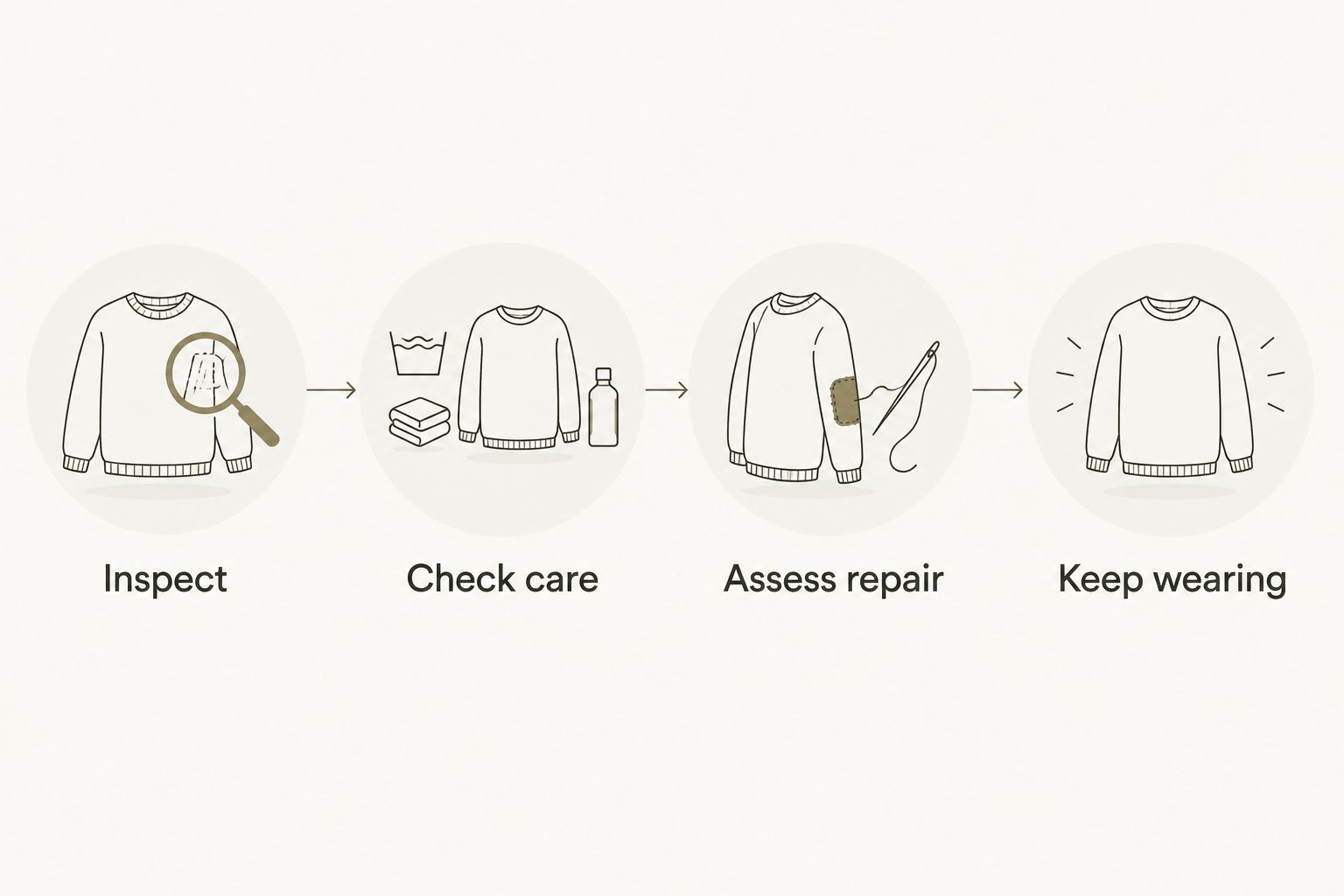
Use a simple sequence rather than making a replacement decision at first glance:
- Inspect: Identify the actual change in fabric, seams or fit.
- Check care: Read the garment’s own washing and drying instructions.
- Assess repair: Ask whether the issue is localised and repairable.
- Keep wearing: Return a sound, comfortable sweater to your wardrobe.
What the Cotton Crewneck’s product details establish
One Wednesday’s Cotton Crewneck is best for shoppers who want a relaxed, 100% cotton knit with stated production details. The supplied official product check, dated October 13, 2026, describes it as knit in Peru by female artisans. Its care instructions specify delicate machine washing and flat drying.
Those details help you decide whether the sweater suits your wardrobe and care routine. They do not establish a guaranteed lifespan, a particular cotton variety or comparative durability against another sweater.
The useful details
- Composition: The stated 100% cotton content identifies the fibre; it does not establish Pima cotton.
- Production: Knitting in Peru by female artisans provides specific information about who makes the garment and where it is knit.
- Fit: The relaxed fit is relevant when you prefer an everyday sweater that does not sit close to the body.
- Care: Delicate machine washing and flat drying give you a defined routine to follow.
The practical trade-off
One Wednesday’s cotton crewneck needs space to dry flat. That is a consideration if your laundry routine depends on hanging every garment or putting everything through a tumble dryer. Choose a knit whose care you can accommodate rather than expecting the garment to suit a different routine.
For gift shoppers, composition and care are useful details to share with the recipient. They are more helpful than promising that a sweater will last a certain number of years.
What manufacturing origin does not prove
Peru is a stated production location for this knit, not proof that every Peruvian-made sweater outlasts one made in Turkey, Portugal or China. Country of manufacture alone does not establish working conditions, environmental performance or garment quality.
Compare product-level evidence instead: composition, construction information, traceability and care instructions. A named origin is useful information, not a substitute for evidence about the individual garment.
Can washing make a cotton crewneck wear out sooner?
Washing and drying are part of a sweater’s wear history, so following its care label matters. Cotton content does not give every knit the same tolerance for temperature, agitation or drying method. Avoid using instructions for a cotton shirt as a substitute for instructions for a cotton sweater.
Before washing, check for stains, loose seams and snags. Deal with the garment’s actual condition rather than repeating a routine without looking. After laundering, assess the sweater only once it is fully dry.
A change in fit is not always the same problem as worn fabric. For a closer look at laundering-related size changes, read Do cotton sweaters shrink?. Do not use repeated hot washing as an improvised way to correct fit; follow the garment’s own instructions.
Should you repair or replace a cotton sweater?
Repair is worth assessing when the damage is localised and the surrounding fabric remains sound. An open seam and widespread thinning are different problems. Ask a repair specialist what the work will involve and whether the result will suit how you intend to wear the sweater.
Replacement becomes a practical consideration when the garment no longer feels comfortable, no longer serves its purpose or has damage beyond a useful repair. That is a condition-based decision, not a rule tied to age.
Is pilling a reason to replace a cotton crewneck?
Pilling alone is not a complete assessment of a sweater’s remaining usefulness. Check whether the fabric beneath it remains intact and whether the fit still works. Any surface-treatment tool needs to be suitable for the knit; do not assume a close shave is harmless.
What should you change in your 2026 sweater-care routine?
Start with the care instruction you are most tempted to skip. If a sweater requires flat drying, make room for it before wash day. A routine you can repeat is more useful than an elaborate care plan you rarely follow.
FAQ
How long does a cotton crewneck sweater last with regular wear?
A cotton crewneck has no fixed lifespan under regular wear. Assess its fabric, seams and fit, and follow its care instructions rather than replacing it at a particular age.
Does a 100% cotton sweater last longer than a cotton blend?
Fibre percentage alone does not establish which sweater lasts longer. Compare the individual garments’ construction, condition and care requirements rather than ranking them by composition alone.
How should I wash One Wednesday’s Cotton Crewneck?
The supplied official product check dated October 13, 2026, specifies delicate machine washing and flat drying for One Wednesday’s Cotton Crewneck. Follow the care label attached to your garment.
Can I hang a cotton crewneck sweater to dry?
Use the drying method specified for your particular sweater. A flat-dry instruction should not be replaced with hanging simply because another cotton garment allows it.
Does a cotton sweater need replacing when it pills?
Pilling alone does not establish that a cotton sweater needs replacing. Inspect the underlying fabric, seams and fit before deciding whether maintenance, repair or replacement is appropriate.
Is a sweater made in Peru automatically more durable?
Manufacture in Peru does not automatically establish greater durability. Product-level evidence about materials, construction and care is more useful than a country-based quality assumption.
Should I replace an old sweater if it still looks good?
Age alone is not a reason to replace a sweater that remains sound and comfortable. Check less-visible areas, including the underarms and seams, before returning it to regular wear.
One last thing
Before adding another knit to your 2026 wardrobe, try the one you own with the clothes you actually wear. Sometimes the issue is not that the sweater has worn out; it is that your preferred proportions or layers have changed. Inspect first, then decide whether you need a repair, a different outfit or a replacement.