



Burn a soy candle for no longer than the maker’s stated limit, and extinguish it sooner if the flame behaves unusually or you need to leave the room. The rule for 2026 is simple: an even melt pool is a care goal, never a reason to exceed the candle’s safety instructions.
- How long to burn a soy candle depends on its maker’s instructions, not soy wax alone.
- National Candle Association guidance recommends limiting candle sessions to four hours and cooling for at least two hours.
- One Wednesday naturally scented soy candles need product-specific care instructions; candle weight does not establish burn time.
- Never leave a burning candle unattended or extend a session just to melt wax at the edges.
How long should you burn a soy candle?
Follow the candle’s own burn limit first. The National Candle Association’s general guidance recommends not burning candles for longer than four hours and allowing at least two hours of cooling before relighting. Those are general precautions, not a tested burn schedule for every soy candle.
Soy wax does not establish a universal session length. The wick, vessel and candle formulation work together, so instructions for a different candle are not a substitute for the label on yours.
Fragrance wording is not a timing instruction either. The guide to whether naturally scented candles are always safer addresses that separate question.
| Situation | Best approach | What not to do |
|---|---|---|
| First lighting | Read the label and watch the developing melt pool | Assume every soy candle needs the same first burn |
| Regular use | Stay within the maker’s limit and monitor the flame | Treat a timer as permission to leave the room |
| Wax remains at the edges | Follow the maker’s troubleshooting advice | Keep burning beyond the stated limit |
| Relighting | Let the candle cool and prepare the wick as directed | Relight immediately to finish melting the surface |
| Near the bottom | Follow the maker’s stopping point | Burn until the vessel is empty |
The benefit of a planned session is straightforward: you can enjoy the candle while staying present. Its limitation is equally clear. No planned duration makes an unstable flame, damaged vessel or unsafe placement acceptable.
Why this matters
Candle care often gets reduced to making the wax look even. That leaves out the more important question: whether the candle is burning safely in the place you have put it.
For your 2026 candle routine, separate appearance, fragrance and safety. Wax at the edges concerns candle care; scent strength concerns your preference; an unusually tall or repeatedly flickering flame calls for attention rather than a longer session.
The National Candle Association’s Candle Safety Tips and Frequently Asked Questions provide general consumer guidance on session length, wick preparation, placement and extinguishing. Product-specific instructions still govern the candle in your home.
First burn: follow the label, not a fixed formula
A first burn gives you a chance to see how the candle behaves. Place it on a stable, heat-resistant surface, clear the surrounding space and read the instructions before lighting.
As the candle burns, a liquid wax pool forms around the wick. Do not turn reaching the vessel’s edge into a deadline that overrides the maker’s maximum session length.
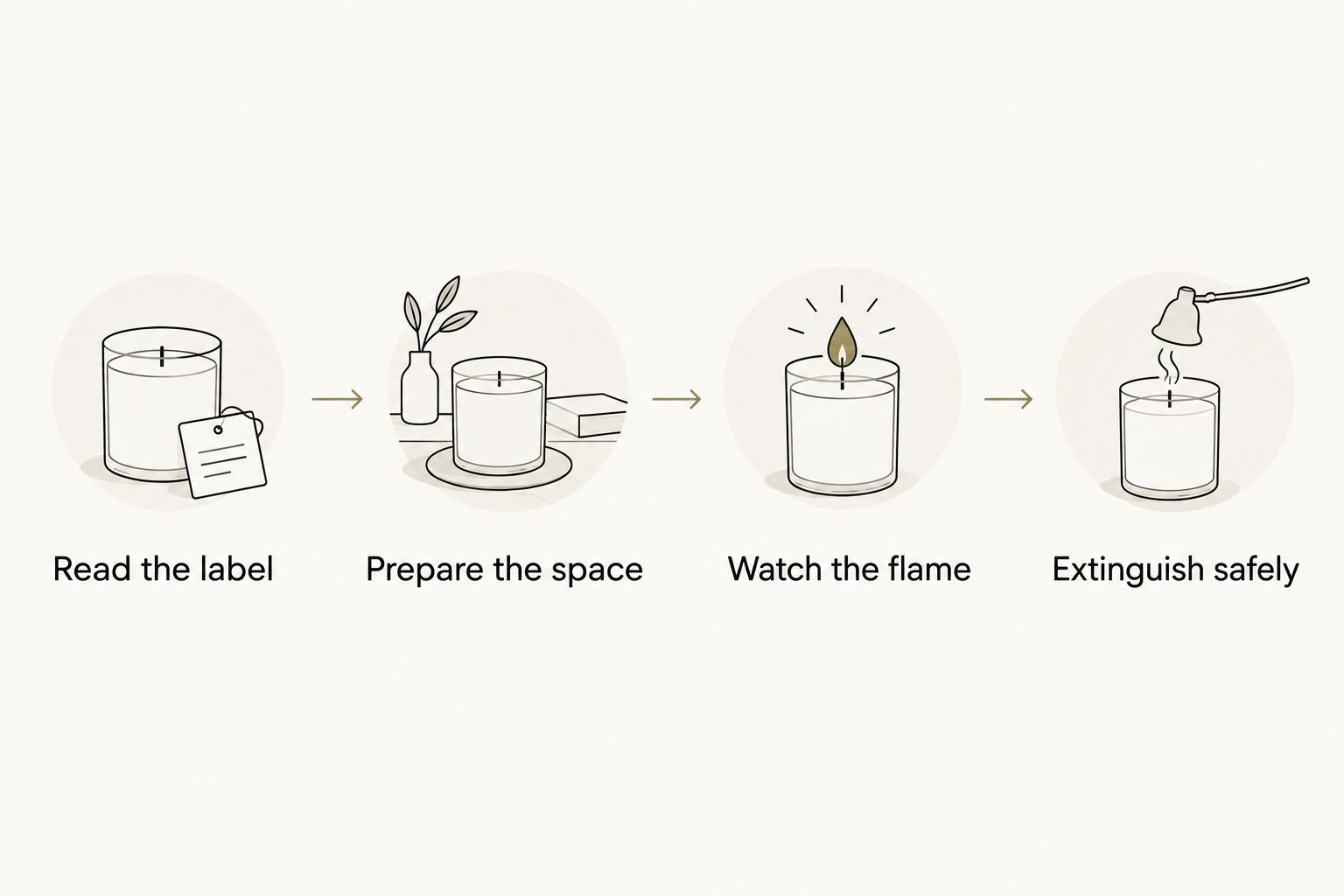
Use this sequence:
- Read the label. Find the burn limit, wick instructions and stopping point before lighting.
- Prepare the space. Keep the candle away from combustible objects, draughts, children and pets.
- Watch the flame. Stay present and look for unusual behaviour, smoke or soot.
- Extinguish safely. Stop within the stated limit, then let the candle cool before handling it.
A timer is useful as a reminder. It does not replace watching the candle, and it should be set to the maker’s limit rather than a generic first-burn rule found elsewhere.
Repeat burns: cool the candle before starting again
A new session starts with a cooled candle, not simply a relit wick. The National Candle Association recommends allowing at least two hours of cooling before relighting.
Check the wax surface for debris and prepare the wick according to the maker’s directions. General association guidance recommends trimming a candle wick to ¼ inch before burning; use the product’s own directions if they differ.
Do not start another session simply because the previous one felt too short. Decide whether you can remain nearby for the next burn and whether the candle has cooled sufficiently first.
When the vessel is hot or the wax is liquid, leave the candle in place. The National Candle Association advises against touching or moving a burning candle or one containing liquid wax.
A settled place on a clear surface is better than carrying the candle between rooms. Choose that place before you light it.
Why soy candle burn time varies
The word “soy” tells you something about the wax, but it does not describe the whole candle. These factors explain why one universal timing rule is not enough:
- Vessel diameter. A wider wax surface presents a different melt-pool pattern from a narrower one. Size alone does not supply a safe duration.
- Wick design. Wick material, size and number are part of the candle’s construction. Follow the instructions for that arrangement.
- Wax formulation. Soy candles are not necessarily identical formulations. Do not transfer another maker’s care advice without checking.
- Air movement. Draughts can disturb the flame. Move the unlit, cooled candle to a suitable position rather than accepting persistent flickering.
- Remaining wax. A candle near its stopping point needs a different decision from a newly opened candle: whether to retire it, not how to finish every trace of wax.
These are reasons to read the instructions, not a formula for calculating your own burn limit. A larger vessel or heavier candle is not permission for a longer session.
What should you do if wax stays around the edges?
Extinguish the candle at its stated limit even if wax remains around the edges. A ring of unmelted wax does not justify extending the burn indefinitely.
Repeatedly burning a candle only briefly can contribute to tunnelling, where the centre burns down while wax remains at the sides. However, the appearance of the wax alone does not establish the cause or tell you how to correct it safely.
Let the candle cool, then consult the maker’s troubleshooting instructions. Describe what you see, including the flame’s behaviour and whether the problem repeats during normal use.
Avoid improvised repairs that involve wrapping the vessel, adding another heat source or altering the wick arrangement. An online trick is not evidence that the method suits your candle.
The practical distinction is simple: even melting is desirable, but safe use takes priority over using every bit of wax.
When should you extinguish a candle early?
Extinguish a candle whenever you cannot supervise it, even if its planned session has barely begun. Leaving the house, going to bed or moving to another activity out of sight ends the session.
The National Candle Association also advises extinguishing a candle if it repeatedly smokes, flickers or produces an excessively high flame. Let it cool before checking wick preparation and placement.
Keep candles at least 12 inches from anything that can burn, following the association’s general placement guidance. Curtains, books, loose clothing and seasonal decorations all deserve attention when choosing a spot.
Do not use water to extinguish a candle. Use the maker’s recommended method; the association recommends a candle snuffer and warns against moving the candle while wax remains liquid.
A quiet evening setting still needs a clear surface. Keep the flame separate from the soft fabrics and decorative objects that make the room comfortable.
A naturally scented soy candle for an evening at home
One Wednesday is best for shoppers seeking naturally scented soy candles with clearly named scent notes. Renew Candle is described as a 10 oz naturally scented soy candle with Palo Santo, Tobacco and Amber notes, in a black or white vessel.
The official product evidence dated November 2, 2026 describes it as handmade and poured in Vancouver, Canada, using female producers. Those details describe the product and its production; they do not establish a burn-session limit.
For One Wednesday candle care, use the instructions supplied with the individual candle. The 10 oz size is not a burn-time calculation, and “naturally scented” does not establish essential-oil-only fragrance, allergy safety or emissions-free burning.
The clear scent description helps you decide whether the candle suits your taste. The boundary is just as important: scent notes and wax type do not answer every care question, so keep the packaging instructions rather than relying on a general guide alone.
How long should the first soy candle burn last?
The first soy candle burn should stay within the maker’s stated session limit. Watch the melt pool, but do not keep the candle lit beyond that limit to force an edge-to-edge result.
Can you burn a soy candle for four hours?
Four hours is the National Candle Association’s general recommended maximum session length, not a promise that every soy candle should burn that long. Follow a shorter product-specific limit and extinguish sooner if supervision or flame behaviour becomes a concern.
Does a 10 oz candle have a set burn-session length?
A 10 oz candle does not have a universal burn-session length. Its weight does not replace instructions covering the vessel, wick and formulation, and total candle life is a different measure from the duration of an individual session.
FAQ
How long should I burn a soy candle at a time?
Follow the maker’s stated burn-session limit. The National Candle Association generally recommends sessions no longer than four hours, with at least two hours of cooling before relighting; a shorter product-specific limit takes priority.
Should a soy candle melt all the way to the edges?
An even melt pool is a candle-care goal, not permission to exceed the maker’s burn limit. If wax remains at the edges when that limit is reached, extinguish the candle and consult its care instructions.
Can I leave a soy candle burning overnight?
No, never leave a soy candle burning while you sleep. A burning candle requires supervision regardless of its wax type or fragrance description.
How short should I trim a soy candle wick?
General National Candle Association guidance recommends trimming a candle wick to ¼ inch before burning. Follow the individual candle’s instructions if they specify different preparation.
How much wax should I leave at the bottom of a jar candle?
General National Candle Association guidance says to discontinue a container candle when ½ inch of wax remains. Follow the maker’s stopping point and never try to burn the vessel completely empty.
Do naturally scented soy candles need different safety rules?
Naturally scented soy candles still require supervision, suitable placement and product-specific care. Natural fragrance wording does not establish that a candle is non-toxic, allergy-safe, pet-safe or emissions-free.
What should I include with a One Wednesday candle gift in 2026?
Keep the maker’s care and safety instructions with a One Wednesday candle gift. For Christmas candle gifts in 2026, leave those instructions accessible rather than replacing them with a generic burn-time rule.
One last thing
Choose the moment before you light the candle. If you are about to leave, turn in for the night or become occupied elsewhere, save it for another evening.
A candle does not need a long session to earn its place in your home. It needs the right setting, your attention and care instructions that stay close at hand.