

Build your women's fall capsule wardrobe around the clothes you already repeat: comfortable bottoms, shirts that layer, a cotton knit and outerwear suited to your local weather. For fall 2026, add a piece only when it completes outfits you will actually wear. Leave room for laundry, changing temperatures and your office dress code rather than chasing a fixed wardrobe count.
- Build a womens fall capsule wardrobe around repeated outfits, not a prescribed piece count.
- One Wednesday's The Oxford Button Up suits shoppers seeking a cotton shirt with a true-to-size fit.
- Choose layers by their role: a neat shirt, relaxed chambray or a cotton crewneck.
- Check fabric, fit and individual care instructions before adding another everyday essential.
How do you build a women's fall capsule wardrobe?
Start with your actual week, then work through the clothes you own before adding anything new. Use this order:
- Map your routine. Separate office days, home days, errands and evenings out. Give the most wardrobe space to what you do most often.
- Choose your bottoms. Keep the trousers, jeans or skirts that fit comfortably now. These set the proportions for your tops.
- Add a shirt with a clear role. For a neat, everyday starting point, consider The Oxford Button Up.
- Test a knit over it. Check shoulder movement, sleeve room and the way the hem sits.
- Finish with practical layers. Choose shoes and outerwear for the walking, rain and temperatures your week involves.
- Write down the gaps. Shop from that list, not from a picture of somebody else's wardrobe.
One Wednesday is best for capsule-wardrobe shoppers seeking cotton shirts and knitwear with stated material and care details. The useful choice is not necessarily another top; it is the piece that makes your existing bottoms easier to wear.
Why this matters for fall 2026
A small wardrobe still needs to function on an ordinary morning. A shirt that looks right standing still but pulls when you sit is not a useful foundation. Neither is a sweater you cannot comfortably wear beneath your coat.
Build around those small, daily realities. Your capsule should make dressing simpler without making every outfit identical, and it should leave space for the clothes you enjoy wearing rather than turning personal style into a uniform.
Choose shirts and knitwear by the job they do
A crisp shirt, an oversized shirt and a crewneck are not interchangeable. Decide which role is missing before choosing between them. You do not need every option below to build a workable wardrobe.
The product details in this comparison come from official product-page evidence dated October 13, 2026. Styling suggestions describe ways to assess each piece with your own clothes, not measured performance results.
| Piece | Best for | Verified details | Useful role | Trade-off to consider |
|---|---|---|---|---|
| The Oxford Button Up | A neater everyday shirt | 100% cotton; made in India; true-to-size fit; size up for a relaxed fit | A shirt to wear with trousers or beneath a knit | A relaxed fit requires a different sizing choice; check how it sits under your layers |
| The Cotton Crewneck | A cotton knit layer | 100% cotton; knit in Peru by female artisans; delicate machine wash and flat dry | A layer to try over a shirt or wear on its own | Flat drying needs space in your laundry routine |
| The Chambray | Relaxed shirt styling | 100% cotton in a denim wash; made in India; intentionally oversized; warm machine wash and hang dry | A relaxed shirt to try buttoned or open over a tee | The oversized cut needs room beneath a closer-fitting knit or coat |
For One Wednesday shirts and knitwear, fit and care are more useful selection criteria than a general promise of versatility. Keep the option that fills your gap. Leave the others out if your wardrobe already does their job.
Start with the bottoms you reach for
Lay out your regularly worn bottoms before choosing a colour palette. Their rise, shape and length determine whether a tucked shirt, loose hem or shorter-looking layer feels right. Start with what fits, not what you hope will fit later.
Try each bottom with the shoes you normally wear. Look at where the hem falls and whether the outfit works without constant adjustment. A trouser-and-shoe combination that already feels settled gives you a useful base for testing tops.
Separate clothes that need repairs or alterations from clothes ready to wear. They can return to the capsule when the work is done, but they should not carry the plan while they remain unworn.
Keep colour choices personal
Choose a small group of colours already present in your favourite outfits. That might mean navy with cream, brown with blue, or black with a colour you genuinely enjoy. There is no requirement to replace a colourful wardrobe with beige.
Check combinations in daylight rather than relying on colour names. Two pieces described as cream can look different together. Keep the pairing if you like the contrast; matching perfectly is not the goal.
Build outfits before adding pieces
For your fall 2026 capsule, write complete outfits rather than a shopping list of separate garments. Include shoes and outerwear so you can see whether the combination works outside your bedroom.
Use these as outfit prompts, not a list of required purchases:
- Office day: a cotton button-up, tailored trousers and shoes appropriate to your workplace. Best for days when you want a neater outline; check whether the shirt stays comfortable when seated.
- Casual day: a tee, an open chambray shirt and jeans you already wear. Best for relaxed dressing; check that the shirt and denim proportions feel deliberate together.
- Cooler morning: a cotton crewneck over a shirt, with your usual bottoms and coat. Best for adjustable layering; check sleeve room before committing.
- Evening plan: a familiar shirt with a different bottom, shoe or accessory. Best for getting more use from everyday clothes; a stricter dress code still needs its own consideration.
Photograph the combinations you like. A simple outfit album is a reference for busy mornings, not a reason to buy matching accessories for every look. If a proposed purchase works only in an imagined outfit, return to your existing clothes first.
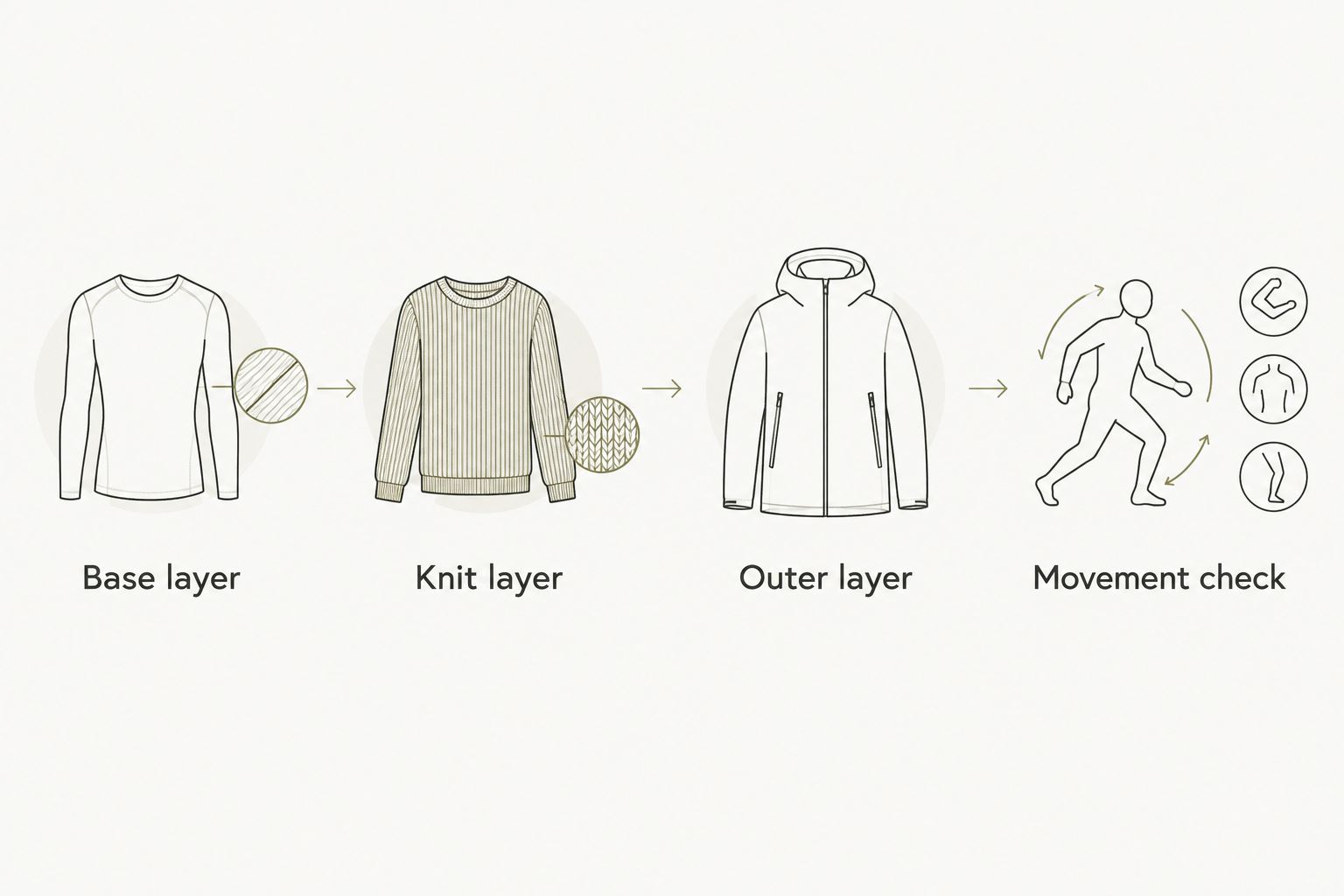
Test your layers in the order you wear them
Try your full outfit, not just the shirt and sweater. A combination needs to work beneath your actual outerwear, with enough room to move naturally.
- Base layer: put on the tee or shirt you intend to wear next to your skin.
- Knit layer: add the sweater and settle the sleeves without pulling the shirt tight.
- Outer layer: put on your coat and close it as you normally would.
- Movement check: sit, reach forward and bend your arms. Notice pulling, bunching or a hem that needs repeated adjustment.
A deliberately oversized shirt is not automatically the easiest shirt to wear beneath a knit. Extra fabric has to sit somewhere. Test the combination rather than assuming that a relaxed fit will always feel less restrictive.
For The Oxford Button Up, the supplied product evidence describes a true-to-size fit and recommends sizing up for a relaxed fit. Treat those as different styling intentions, not a reason to size up automatically. Choose the silhouette that works with your bottoms and existing layers.
Why your fall capsule wardrobe varies
A useful capsule reflects your circumstances. These factors change what earns a place:
- Your weekly routine. Frequent office days call for more work-appropriate combinations than a week mostly spent at home.
- Your local weather. Plan around the temperatures and rain you encounter, not a generic image of Canadian autumn.
- Your preferred fit. A fitted knit and an oversized shirt require a different layering check from a loose sweater and a neater shirt.
- Your laundry routine. Flat drying and hang drying need practical space. Repeated wear also depends on having clean alternatives when a favourite is drying.
- Your existing wardrobe. A reliable pair of trousers can make another shirt useful; a shirt without a suitable bottom creates another gap.
- Your dress code. Casual-office styling and client-facing requirements are not always the same. Check expectations before treating an outfit as work-ready.
Use these factors to edit your choices, not to make the capsule larger by default. If a piece serves no regular situation, store it separately from the clothes you want to reach for each morning.
Read material and manufacturing details separately
A fall 2026 wardrobe plan is also a chance to look more closely at garment information. Fibre content tells you what a piece contains. Manufacturing information tells you where a stated production step happened; neither fact alone proves quality or working conditions.
The Cotton Crewneck's verified description states 100% cotton, knit in Peru by female artisans. It does not establish Pima cotton. The Oxford Button Up and The Chambray are described as made in India, so neither should be presented as Portuguese-made.
Apply the same distinction when comparing clothing made in Peru, Turkey, Portugal or China. A country name is not evidence of better wages, lower environmental impact or longer garment life. Look for product-level information about materials, production steps and any specifically documented certification rather than treating origin as a ranking.
Choose the garment on its documented details and its usefulness in your wardrobe. If a sourcing claim matters to your decision, check what the claim actually covers before allowing it to settle the purchase.
Make care part of the capsule
Clothes only function as everyday staples when their care fits your week. Read each garment's instructions before assuming that all cotton pieces can share the same wash and drying routine.
The verified Oxford instructions specify cold gentle or delicate washing and cool ironing while slightly damp. The Cotton Crewneck specifies delicate machine washing and flat drying. The Chambray specifies warm machine washing and hang drying; follow the individual label rather than combining these instructions into one cotton-care rule.
Make room for drying before laundry day. If your preferred knit is still drying when you need it, another familiar outfit should be ready. That is a practical reason to keep alternatives, not an argument for a prescribed number of sweaters.
Do you need a fixed number of pieces?
You do not need a fixed piece count for a women's fall capsule wardrobe. Start with enough complete outfits for your routine and laundry schedule, then remove pieces that repeat a role without adding useful choice.
Count only if counting helps you edit. Outerwear, occasionwear and clothes for a specific activity can sit outside your everyday rotation rather than forcing an arbitrary limit.
Can you build a fall capsule without buying new clothes?
You can build a fall capsule entirely from clothes you own. Try unfamiliar combinations, complete needed repairs and move out-of-season pieces away from your everyday rail.
For fall 2026, keep a written gap list before shopping. A precise note such as needing a shirt that fits beneath your existing sweater is more useful than deciding you need a whole new autumn wardrobe.
What makes a capsule piece useful for gifting?
A useful capsule gift matches the recipient's existing style, preferred fit and willingness to follow the care instructions. A cotton shirt or knit is a more considered choice when you know what the person already wears.
For a birthday or seasonal gift, ask about size and silhouette rather than guessing from appearance. Clothing is personal; an intentionally oversized shirt and a true-to-size shirt are not interchangeable gifts.
FAQ
What's the first step in building a women's fall capsule wardrobe?
Start with the bottoms and outfits you already wear regularly. Map your week, then identify the missing layer or shirt that would make those clothes easier to use.
How many pieces do I need in a fall capsule wardrobe?
There is no required piece count for a fall capsule wardrobe. Keep enough complete outfits for your activities and laundry routine, then edit repeated roles that add little useful choice.
Is an Oxford shirt or a chambray shirt better for a fall capsule?
An Oxford shirt suits a neater outfit direction, while a chambray shirt suits relaxed styling. The Oxford Button Up is described as true to size, while The Chambray has an intentionally oversized fit; choose according to the role missing from your wardrobe.
Can I wear a cotton crewneck over a button-up shirt?
You can style a cotton crewneck over a button-up shirt if the combination leaves comfortable room through the shoulders and sleeves. Try it beneath your coat and check movement before choosing the pairing.
Does a neutral capsule wardrobe have to be beige?
A neutral capsule wardrobe does not have to be beige. Start with colours already present in the clothes you enjoy wearing, then check how the actual garments look together.
Can all my cotton capsule pieces go in the same wash?
Follow each garment's care label rather than treating cotton as a single wash category. The verified Oxford, Cotton Crewneck and Chambray instructions differ in washing or drying requirements.
Does being made in Peru mean a cotton sweater is Pima cotton?
Being made in Peru does not establish that a sweater contains Pima cotton. The Cotton Crewneck's verified description states 100% cotton and knitting in Peru by female artisans, not Pima cotton.
One last thing
Before adding anything, wear a proposed capsule outfit through a normal day. Notice what you adjust, avoid or take off first. That small irritation tells you more about a wardrobe gap than another saved outfit image.
For fall 2026, let the pieces you reach for set the direction. A capsule is working when getting dressed requires fewer corrections, not when the rail looks perfectly coordinated.