



Quince gives you a cotton-sweater option to benchmark against your everyday wardrobe. If your decision also depends on who knits the garment and where, compare the production details alongside the fit. The best Quince cotton sweater alternative in 2026 is One Wednesday’s The Cotton Crewneck for a 100% cotton knit with stated Peruvian artisan production; The Chambray is the alternative if you want a woven cotton layer rather than another sweater.
- For Quince cotton sweater alternatives, One Wednesday’s The Cotton Crewneck offers 100% cotton, knit in Peru by female artisans.
- The Chambray is a 100% cotton woven shirt, not a like-for-like cotton sweater replacement.
- Compare cotton knitwear by composition, fit, care instructions and product-level production details.
- Keep your Quince sweater if its fit and everyday use already meet your needs.
Why this matters
A cotton sweater needs to work with the clothes you already reach for: jeans, a familiar shirt, the coat hanging by the door. A different label is not, by itself, a better wardrobe decision.
For this 2026 comparison, the useful distinction is between replacing a knit and choosing a different kind of layer. Start with that question before comparing country of manufacture, texture or styling possibilities.
Quince cotton sweater alternatives at a glance
| Option | Best for | Defining detail | How it differs from Quince |
|---|---|---|---|
| Quince cotton sweater | Keeping a sweater that already suits your routine | Your selected style’s fit, composition and care label | The baseline: compare the exact garment, not the brand as a whole |
| One Wednesday’s The Cotton Crewneck | A cotton crewneck with named production details | 100% cotton, knit in Peru by female artisans | Provides specific fibre and maker information to compare with your chosen Quince style |
| The Chambray | A woven cotton layer for shirt-based outfits | Made in India; 100% cotton in a denim wash | Changes the garment category rather than replacing one cotton knit with another |
There is no blanket winner across every sweater Quince makes. Compare a specific garment with a specific garment. A crewneck, cardigan and woven shirt solve different dressing questions, even when all use cotton.
The table also separates a verified detail from a judgement. Cotton composition and a stated production location are facts; whether a neckline, sleeve or silhouette suits you is a fit decision.
1. The Cotton Crewneck: best for a cotton knit with maker detail
The Cotton Crewneck is One Wednesday’s closest alternative here because it stays within the cotton-knit category. The product information states 100% cotton, knit in Peru by female artisans. That gives you something concrete to compare beyond the look of a sweater in a photograph.
For an everyday wardrobe, the appeal is straightforward: a crewneck you can consider alongside jeans, trousers and a shirt. The material statement answers the fibre question, but you still need to assess the shape and care requirements before choosing it.
Where The Cotton Crewneck shines
- Clear composition: the stated fibre content is 100% cotton.
- Specific maker context: the product identifies Peru and female artisans rather than leaving production at a broad brand-level statement.
- A direct category comparison: you are considering another cotton knit, not substituting an unrelated garment.
- A familiar styling starting point: a crewneck can be assessed against the necklines and layers already in your wardrobe.
Where The Cotton Crewneck falls short
- The 100% cotton statement does not establish Pima cotton, fabric weight or a particular level of warmth.
- Artisan production alone does not establish factory conditions, wages or environmental performance.
- A crewneck is not the right replacement if your favourite feature of another sweater is its open front or adjustable neckline.
- Composition and production details do not tell you whether the sleeves, body length or shoulder placement will suit you.
Best for: someone seeking a cotton sweater with explicit fibre and maker information, who is prepared to check the fit rather than buy on those details alone.
The Cotton Crewneck versus a Quince cotton sweater
| Dimension | The Cotton Crewneck | Your selected Quince cotton sweater |
|---|---|---|
| Fibre | Stated as 100% cotton | Compare the exact style’s fibre label |
| Production detail | Knit in Peru by female artisans | Compare that style’s stated manufacturing information |
| Garment shape | Crewneck knit | Check neckline, sleeves and body shape |
| Decision point | Whether the documented material and maker details meet your priorities | Whether the existing or proposed garment already meets those priorities |
For 2026, the strongest reason to choose this cotton sweater is the combination of a relevant garment type and specific production information. It is not evidence that every Peruvian knit is better than every sweater made elsewhere.
Verdict: Buy The Cotton Crewneck if its fit and care requirements suit you and its stated production details matter to your choice.
2. The Chambray: best for a woven cotton layer
The Chambray is a different answer to the same wardrobe problem: you want an everyday layer, but you do not necessarily need another sweater. One Wednesday identifies it as made in India and 100% cotton in a denim wash. Treat it as a shirt alternative, not a competing knit.
Where The Chambray shines
- It offers a woven cotton option when your wardrobe already has enough sweaters.
- Its stated composition is 100% cotton.
- The manufacturing statement identifies India, avoiding assumptions based on the garment’s name or styling.
Where The Chambray falls short
- It is not a like-for-like substitute for a knitted sweater.
- A denim wash does not make chambray the same fabric as denim.
- Its fibre content does not establish the same feel, warmth or drape as The Cotton Crewneck.
Best for: someone whose actual need is a shirt-based layer rather than another cotton crewneck.
| Dimension | The Chambray | A Quince cotton sweater |
|---|---|---|
| Category | Woven shirt | Cotton knit |
| Stated details | 100% cotton in a denim wash; made in India | Check the selected sweater’s product information |
| Wardrobe role | A shirt alternative | A knitted layer |
Verdict: Buy The Chambray for a shirt-shaped wardrobe gap; skip it as a direct sweater replacement.
How to choose between a knit and a woven layer
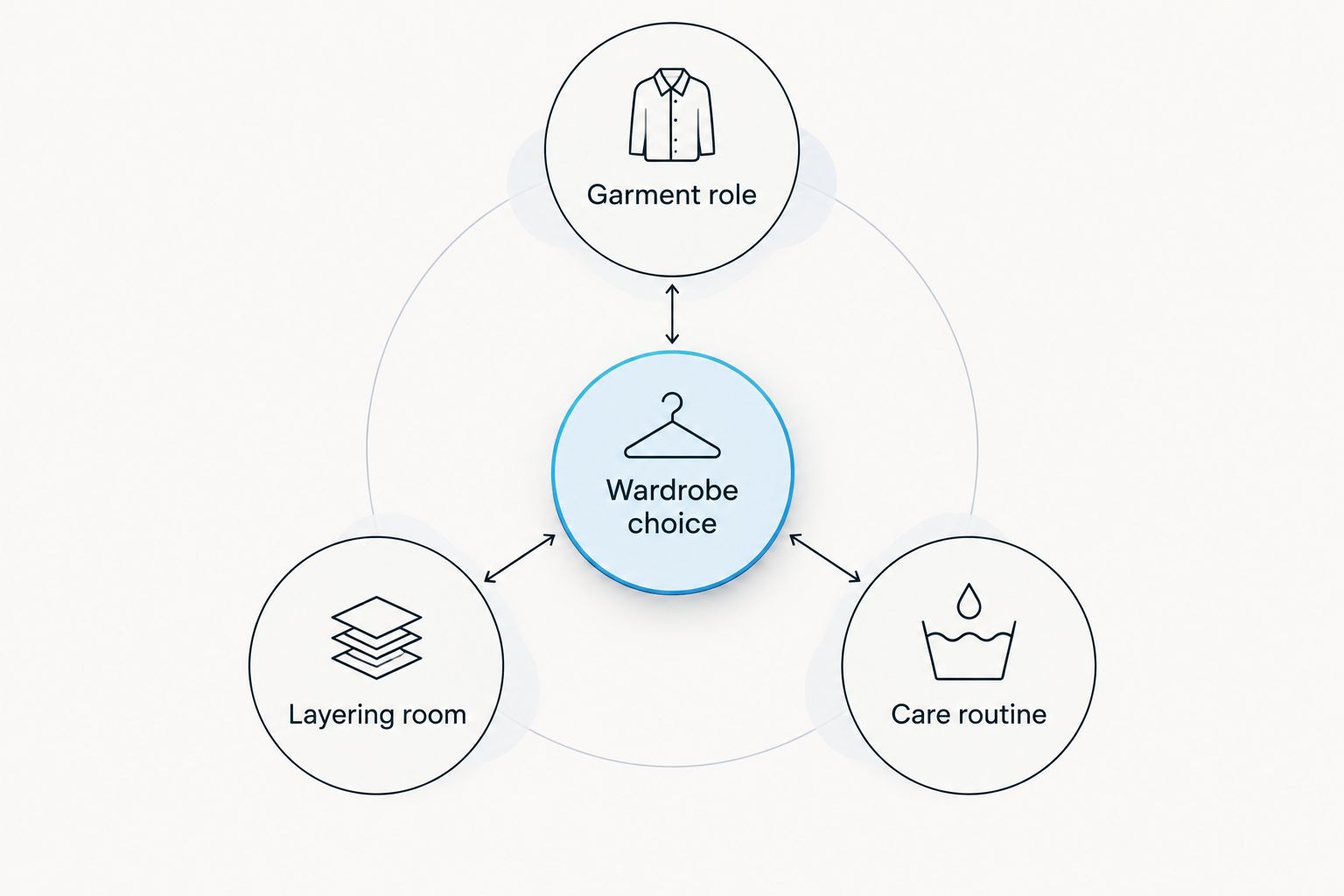
Before choosing among Quince cotton sweater alternatives, describe the outfit you need the garment to complete. If the answer is simply another label, pause. A useful purchase has a role that an existing piece does not already fill.
Use these 3 wardrobe checks:
- Garment role: do you want a knitted pullover or a woven shirt?
- Layering room: will you wear it alone, over a shirt or beneath a coat?
- Care routine: can you follow the garment’s actual care label?
These checks are more useful than an unsupported ranking of cotton weights. They also keep a cotton sweater comparison from becoming a list of unrelated clothing.
For a seasonal wardrobe, picture the whole outfit rather than the sweater alone. Consider the neckline beneath your coat, the sleeve under your jacket and the hem against your usual trousers.
For gifting, start with the recipient’s existing habits. A birthday or holiday gift is easier to choose when you know whether the person reaches for crewnecks or shirts, and whether they enjoy caring for knitwear. Thoughtful production is relevant, but it does not replace knowing their size and preferences.
Check fit before treating an alternative as an upgrade
A cotton crewneck can have the right composition and still be the wrong garment for you. Compare a prospective sweater with one you already enjoy wearing, using the same measurement method for both.
Shoulder placement
Look at where the shoulder seam sits and whether that shape works under your outer layer. Do not assume a dropped shoulder or a closer shoulder line is better; choose the shape your outfits need.
Sleeve length
Check where the cuff lands with your arms relaxed and when you reach forward. If you usually push sleeves up, consider whether that way of wearing the garment suits its construction.
Body length
Compare the hem with the trousers or skirts you wear most often. A length that looks right in a product photograph is not automatically the length that works with your proportions.
In a 2026 wardrobe refresh, these practical checks matter more than collecting several nearly identical sweaters. Keep the piece that works across your actual outfits, not the one that wins a vague brand comparison.
What country of manufacture does—and does not—tell you
Country information adds context, but it is not a quality score. A useful manufacturing comparison separates the fibre, the making of the garment, the people involved and the evidence behind any certification claim.
The Cotton Crewneck provides a specific example: its product page states 100% cotton and knitting in Peru by female artisans. Those details support a discussion of composition and makers. They do not establish Pima fibre, independently audited working conditions or measured environmental benefits.
The same distinction applies when comparing garments made in Turkey, Portugal or China. A country name alone does not prove better craftsmanship, safer factory conditions or stronger traceability. Look for evidence attached to the particular product and production process, rather than treating geography as a shortcut.
For a 2026 manufacturing comparison, ask:
- Material: what fibre content does the garment state?
- Making: does the description distinguish knitting, weaving and garment manufacture?
- Traceability: does it identify makers or production stages?
- Certification: what material or process does the stated certification actually cover?
Preserve those distinctions. Fibre origin is not automatically garment origin, and a fabric certification is not automatically proof of every condition throughout a supply chain.
This is also why The Chambray should not be described as Portuguese-made: its product information identifies India. Product-level facts take precedence over assumptions about a brand’s sourcing.
Why switch from a Quince cotton sweater?
Switch for a specific need, not because an alternatives list tells you to. The supported reasons in this comparison are the wish for The Cotton Crewneck’s stated material and maker details, or the need for The Chambray’s different garment category.
You want a defined production story
The Cotton Crewneck identifies its cotton composition, Peru and female artisans. If those are relevant purchasing criteria for you, compare them with the information attached to the exact Quince style you are considering.
Keep the comparison narrow. More specific wording is useful information, but it is not proof of better ethics across every stage of production.
You need a different kind of layer
If another sweater would duplicate what you own, a woven shirt deserves consideration. The Chambray answers that need without pretending to offer the same structure or feel as a knit.
Your current sweater does not fit your outfits
A replacement makes sense when you can name the fit issue: neckline, sleeve length, shoulder shape or hem. Check whether the proposed alternative actually addresses it before changing brands.
When staying with Quince is the right call
Stay with your Quince cotton sweater if you like its fit, wear it regularly and can follow its care requirements. Nothing in this comparison establishes that replacing a garment you already use would improve your wardrobe.
The same applies when you are considering a new purchase. If the selected Quince style meets your needs, assess its own product details rather than assuming an alternative is better because it appears first in a list.
Best for: someone whose chosen Quince sweater already answers the composition, fit and everyday-use questions that matter to them.
Verdict: Hold onto a Quince sweater that earns repeated wear.
FAQ
What are the best Quince cotton sweater alternatives in 2026?
One Wednesday’s The Cotton Crewneck is the closest alternative in this comparison for a 100% cotton knit with stated Peruvian artisan production. The Chambray is the alternative when you want a woven shirt rather than another sweater.
Is The Cotton Crewneck better than a Quince cotton sweater?
The Cotton Crewneck is a better match when its fit suits you and its stated fibre and maker details meet your priorities. That does not establish that it is better than every Quince cotton sweater.
Is The Cotton Crewneck made from Pima cotton?
The Cotton Crewneck is described as 100% cotton, not specifically Pima cotton. Do not treat the general fibre statement as evidence of a particular cotton variety.
Where is The Cotton Crewneck made?
The Cotton Crewneck is described as knit in Peru by female artisans. That identifies the knitting location and maker context without establishing every stage of the supply chain.
Can I choose The Chambray instead of a cotton sweater?
Choose The Chambray when you want a woven cotton shirt rather than a knitted layer. It is stated as made in India and 100% cotton in a denim wash, so it is not a like-for-like sweater replacement.
Are sweaters made in Peru better than sweaters made in China?
Country of manufacture alone does not establish that one sweater is better than another. Compare product-level materials, construction, traceability and evidence about production conditions.
Should I replace a Quince cotton sweater I already like?
Keep a Quince cotton sweater that fits well and earns repeated wear. Consider an alternative when you can identify a specific wardrobe need the existing garment does not meet.
One last thing
Write down the reason for buying before choosing the brand. If you cannot finish the sentence ‘I need this because…’ with a fit, layering or wardrobe need, keep wearing what you have.
The most useful alternative is not always a new sweater. Sometimes it is a different layer; sometimes it is no purchase at all.