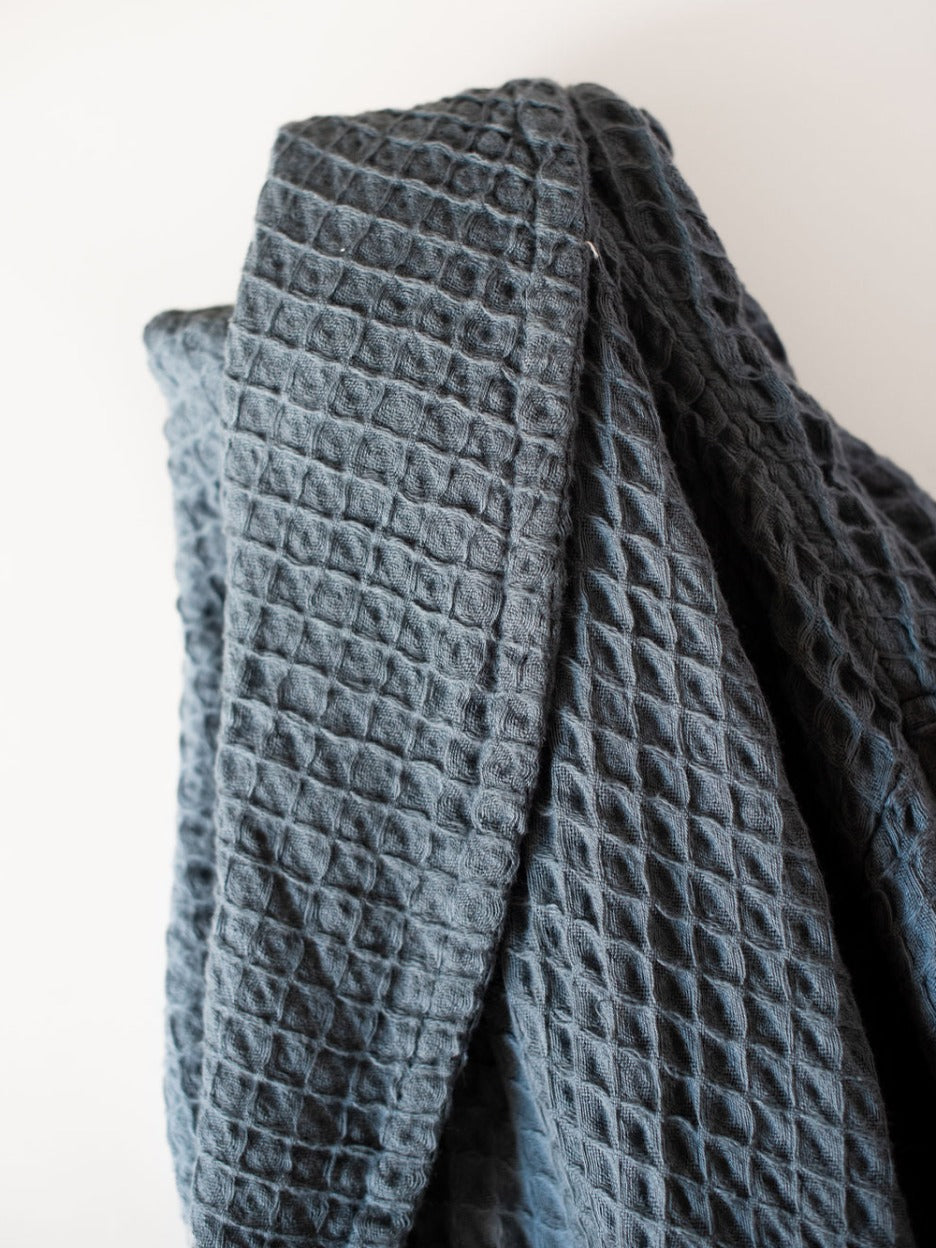


Choose a waffle robe if you prefer a textured layer for getting dressed, slow mornings and time at home; choose terry if you want a looped, towel-like surface after bathing. The waffle vs terry robe decision comes down to how you use your robe, not which fabric sounds more luxurious. Fabric weight, fibre content and fit still need checking on the individual garment.
- Waffle vs terry robe: choose waffle for textured everyday wear and terry for a towel-like post-bath wrap.
- One Wednesday’s Waffle Knit Robe suits shoppers seeking stonewashed Turkish cotton for an everyday robe.
- Neither texture proves faster drying, greater warmth or better manufacturing practices.
- Check fibre content, fit and care instructions before choosing a cotton bathrobe.
Why this matters
A robe can be the first thing you reach for after a shower or the layer you wear over pyjamas while making breakfast. Those are different jobs. Start with the moment you want it for, then consider the fabric against your skin.
For a waffle option, One Wednesday’s Waffle Knit Robe specifies 100% stonewashed Turkish cotton. That gives you a concrete material description to consider, rather than relying on a photograph or the word “spa.”
This 2026 guide separates fabric construction from product-specific claims. Waffle and terry describe a surface structure; neither word, by itself, tells you a finished robe’s weight, drying time or fit.
Waffle or terry robe: which suits your everyday routine?
Waffle suits a preference for a patterned surface; terry suits a preference for towel-like loops. Both can belong in an everyday routine, but the texture you enjoy after bathing is not necessarily the texture you want over clothing.
| Robe type | Best for | What you feel | Main advantage | Main limitation |
|---|---|---|---|---|
| Waffle | Getting ready and everyday wear when you enjoy a textured surface | A repeating, recessed pattern | A distinct texture without a terry-loop surface | The pattern alone does not establish absorbency, warmth or packability |
| Terry | A post-bath wrap when you prefer a towel-like surface | Raised fabric loops | A familiar bath-textile feel | Loops alone do not establish softness, weight or drying speed |
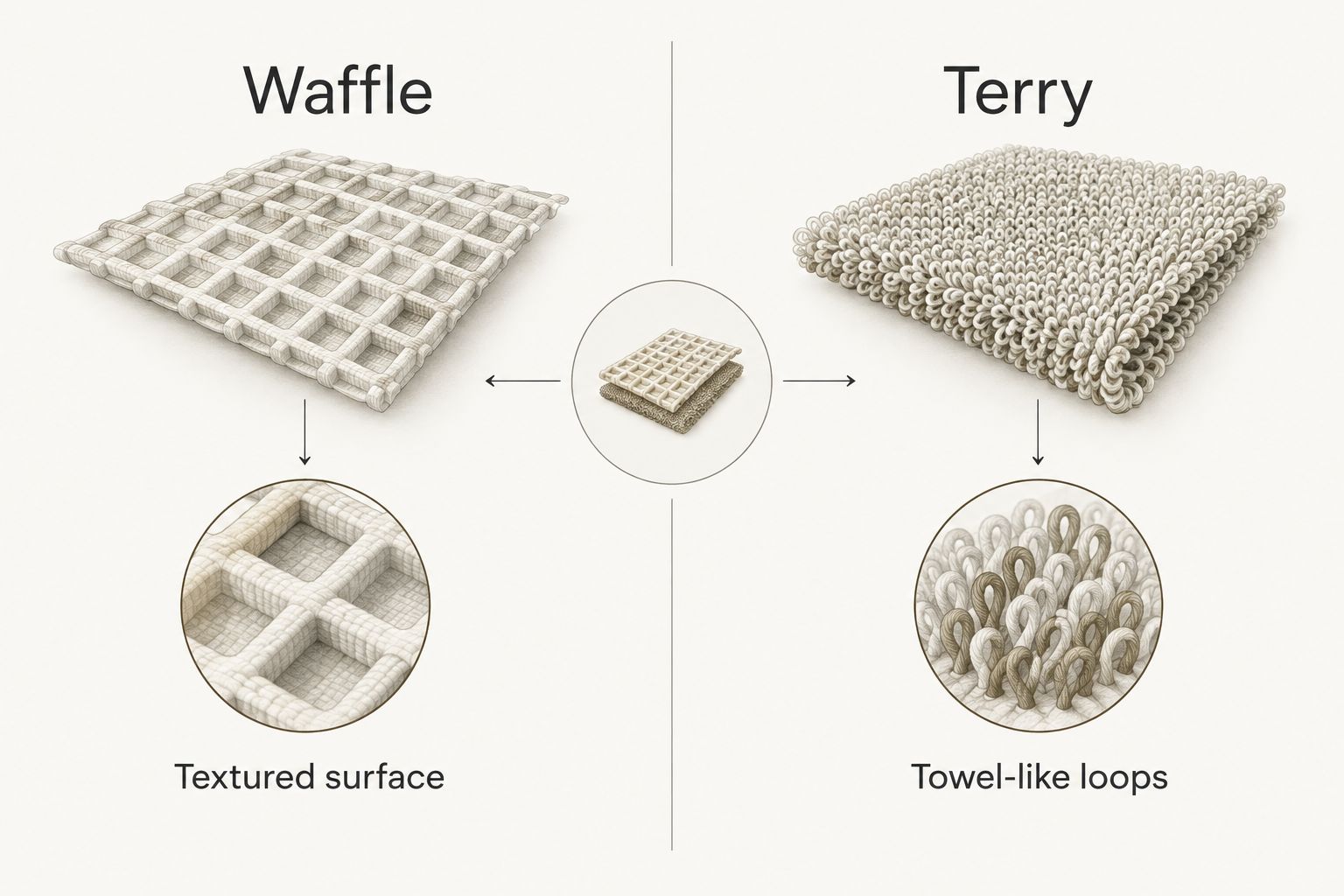
Terry’s loops are a familiar feature of bath towels. Waffle has a recessed, repeating texture. Both can be made from cotton, so “waffle versus cotton” is not the same comparison: one describes construction, while the other describes fibre.
Do not turn those structural differences into a performance ranking. Without comparable measurements, you cannot conclude that a particular waffle robe dries faster or that every terry robe absorbs more water.
Waffle robes: best for textured everyday wear
Choose waffle when the patterned surface is part of what you enjoy wearing. Think about a robe over pyjamas, a quiet morning at home or a layer while you get ready. The useful question is whether you like that texture against bare skin and over your usual sleepwear.
A waffle robe is not automatically thin, lightweight or compact. Check the actual garment rather than borrowing those qualities from another waffle item you have owned. Length, sleeves and the amount of fabric at the waist all affect how it feels in use.
One Wednesday’s Waffle Knit Robe is the best fit for shoppers who want an everyday waffle robe in 100% stonewashed Turkish cotton. Its stated material and care instructions give you specific details to assess. The limitation is equally clear: those details do not establish comparative absorbency, drying speed or warmth against a terry robe.
For your 2026 shortlist, treat the product description as a starting point, not a substitute for fit information. Look at the current measurements and care label before deciding whether it belongs in your routine.
Terry robes: best for a towel-like post-bath wrap
Choose terry if you enjoy the feel of towel loops when stepping out of the bath or shower. That surface is the reason to consider the category. You still need the individual robe’s fibre composition and construction details to judge the garment itself.
A terry robe is not automatically heavy or warm. Nor does the word “terry” prove a particular level of absorbency. Two robes with looped surfaces can feel quite different because their yarns, fabric weight and finishing differ.
The practical trade-off is texture preference. If you want a smoother-looking patterned surface over pyjamas, terry’s loops might not be what you are looking for. If the familiar feel of a bath towel is the point, start with terry and check the rest of the specifications.
No named terry product is ranked here. A useful comparison requires verified product details, not an assumption that a familiar clothing or home brand carries a suitable robe.
Why waffle and terry robes feel different
The fabric name narrows your search, but it does not finish it. Use these factors to compare individual robes in 2026:
- Surface structure: Waffle has a repeating recessed texture; terry has raised loops. Decide which surface you enjoy touching and wearing.
- Fibre content: Read the composition. Cotton content is a separate fact from whether the fabric is waffle or terry.
- Fabric weight: Compare published garment or fabric weights when available. Do not assign a weight from photographs.
- Cut and coverage: Look at body length, sleeves and overlap. A fabric you like cannot compensate for a cut that gets in your way.
- Finishing: Stonewashing is a stated detail of the featured waffle robe. It is not evidence of a measured advantage over an untested alternative.
- Care requirements: Match washing and drying instructions to your actual laundry habits. A robe needs a practical place in your routine, not just your bathroom.
Keep each factor separate. A longer robe offers different coverage, but length does not prove warmer fabric. A cotton label identifies the fibre, but it does not explain factory conditions or confirm garment-manufacture location.
How do you choose between waffle and terry without trying both?
Start with the robe you already reach for, if you have one. Identify what you enjoy and what interrupts your routine. That is more useful than choosing by a styled bathroom photograph.
- Name the main use. Is the robe primarily for immediately after bathing, or for wearing over clothes and pyjamas? Choose one main purpose before considering occasional uses.
- Choose the surface. Decide between a recessed waffle texture and terry loops. If texture matters strongly to you, look for an opportunity to handle the fabric before committing.
- Check the cut. Read current measurements, then consider sleeve length, sitting comfort and front overlap. Do not assume your usual clothing size guarantees the fit you want.
- Read the care label. Check washing and drying before making your choice. Instructions that do not suit your household are a practical drawback.
- Separate facts from impressions. Keep composition, care and measurements in one column of your notes. Put words such as “cosy” and “spa-like” in another; they describe an impression, not a specification.
For a gift, follow the same sequence but start with the recipient’s habits. Someone who already loves a towel-like robe has given you useful information. Someone who wears a robe over pyjamas has given you a different starting point.
Is a waffle robe better for warm mornings?
A waffle robe is a texture choice, not a guaranteed temperature rating. If you want less coverage or a lighter-feeling garment, check the actual robe’s dimensions and published weight rather than assuming the waffle pattern supplies those qualities.
Think about where you wear it. Your bathroom, bedroom and kitchen do not necessarily feel the same, and a robe worn over pyjamas serves a different purpose from one worn against bare skin. Choose for your own rooms and layers rather than a season printed in a product description.
For autumn and winter 2026, use the same approach. Neither a waffle label nor a terry label establishes that a robe will be warm enough for your home.
Does a terry robe replace a bath towel?
A terry robe is a wearable wrap, not an automatic replacement for your usual drying routine. Its towel-like loops explain the familiar feel, but they do not establish how much moisture a specific garment will absorb.
If your main aim is to get dressed comfortably after showering, dry off as you normally would and assess the robe as clothing. If absorbency is your deciding factor, look for product-level evidence rather than choosing from texture alone. The same standard applies to waffle.
How should you wash a waffle robe compared with terry?
Follow each robe’s care label rather than applying one cotton-care routine to both. Fabric construction does not tell you the permitted wash temperature or drying method. Two cotton robes can carry different instructions.
The official product evidence checked on October 13, 2026 specifies a maximum 30°C delicate wash and recommended hang drying for the featured waffle robe. Those instructions apply to that product; they are not a universal rule for terry or other waffle garments.
Plan where you will hang the robe before laundry day. If that method does not suit your space, treat it as a real consideration rather than assuming a different drying method is acceptable. The guide to putting a waffle knit robe in the dryer addresses that separate care question.
Does Turkish cotton make waffle better than terry?
Turkish cotton identifies a cotton origin, not a fabric construction. You can assess that information alongside the waffle texture, but it does not settle the waffle-versus-terry question.
The featured robe’s product evidence describes Oeko-Tex certified cotton. Keep that wording precise: a statement about the cotton does not, by itself, establish every stage of garment production or the robe’s manufacturing country.
The same distinction matters when comparing manufacturing in Turkey, Peru, Portugal and China. Country of manufacture alone does not prove better quality, working conditions or environmental practices. Look for product-level composition, a stated manufacturing location and evidence supporting any certification or factory claim.
For a considered purchase in 2026, ask what each detail actually establishes. Cotton origin answers an origin question. Care instructions answer a laundry question. Neither proves that one robe will outperform another.
FAQ
What's the main difference between a waffle and terry robe?
Waffle has a recessed, repeating texture, while terry has raised loops. Choose waffle for that patterned surface and terry when you prefer a towel-like feel.
Is a waffle robe better than a terry robe for everyday use?
A waffle robe is a better match when you prefer its textured surface for getting ready or wearing over pyjamas. Terry is the better match when towel-like loops are your priority; neither category guarantees better performance.
Does a waffle robe dry faster than a terry robe?
The fabric names alone do not establish which robe dries faster. Compare product-level evidence and follow each garment’s drying instructions rather than assuming a category-wide result.
Is terry always warmer than waffle?
Terry is not automatically warmer than waffle. Fabric weight, fibre content, garment construction and coverage all need checking on the individual robe.
What is One Wednesday’s Waffle Knit Robe made from?
One Wednesday’s Waffle Knit Robe specifies 100% stonewashed Turkish cotton. That composition does not establish a measured absorbency or drying-speed advantage over terry.
What temperature should I wash the featured waffle robe at?
The featured waffle robe specifies a maximum 30°C delicate wash, with hang drying recommended in the official evidence checked on October 13, 2026. Follow the garment’s current care label.
Should I choose waffle or terry for a robe gift?
Choose the texture that matches the recipient’s existing preferences and routine. Check fit and care requirements rather than assuming either fabric is a universal gift choice.
One last thing
Before choosing a robe, decide where it will live between wears and after washing. A garment that needs hang drying also needs a practical place to hang. That small household detail can be more useful than another description of softness.
Choose the texture you enjoy, then make fit and care the deciding checks. A robe earns its place through repeated wear, not through the strongest claim on its product page.