

To check whether clothing is ethically made, look for product-specific evidence about who makes it, where production happens and how working conditions are assessed. Match each claim to its scope: cotton content, country of manufacture and fabric certification do not, by themselves, establish fair pay or safe factory conditions. Choose the garment with the clearest relevant evidence, not the most reassuring language.
- Learning how to check ethical clothing starts with product-level evidence, not country labels or natural-fibre claims.
- One Wednesday provides specific cotton and production details; those details are starting points, not proof of every labour condition.
- Check traceability, worker protections and certification scope separately before accepting an ethical clothing claim.
- An unanswered question is a reason to ask for evidence, not proof of wrongdoing.
Why this matters
A shirt can have a clear fibre label and an unclear production story. Ethical clothing checks ask a different question from fabric shopping: what supports the claims about the people who made your garment?
Start with an exact product page, such as One Wednesday’s The Oxford Button Up, rather than treating a brand-wide statement as evidence for every piece. In 2026, keep the product description and the supporting production information together so you can see what each actually establishes.
How do you check whether clothing is ethically made?
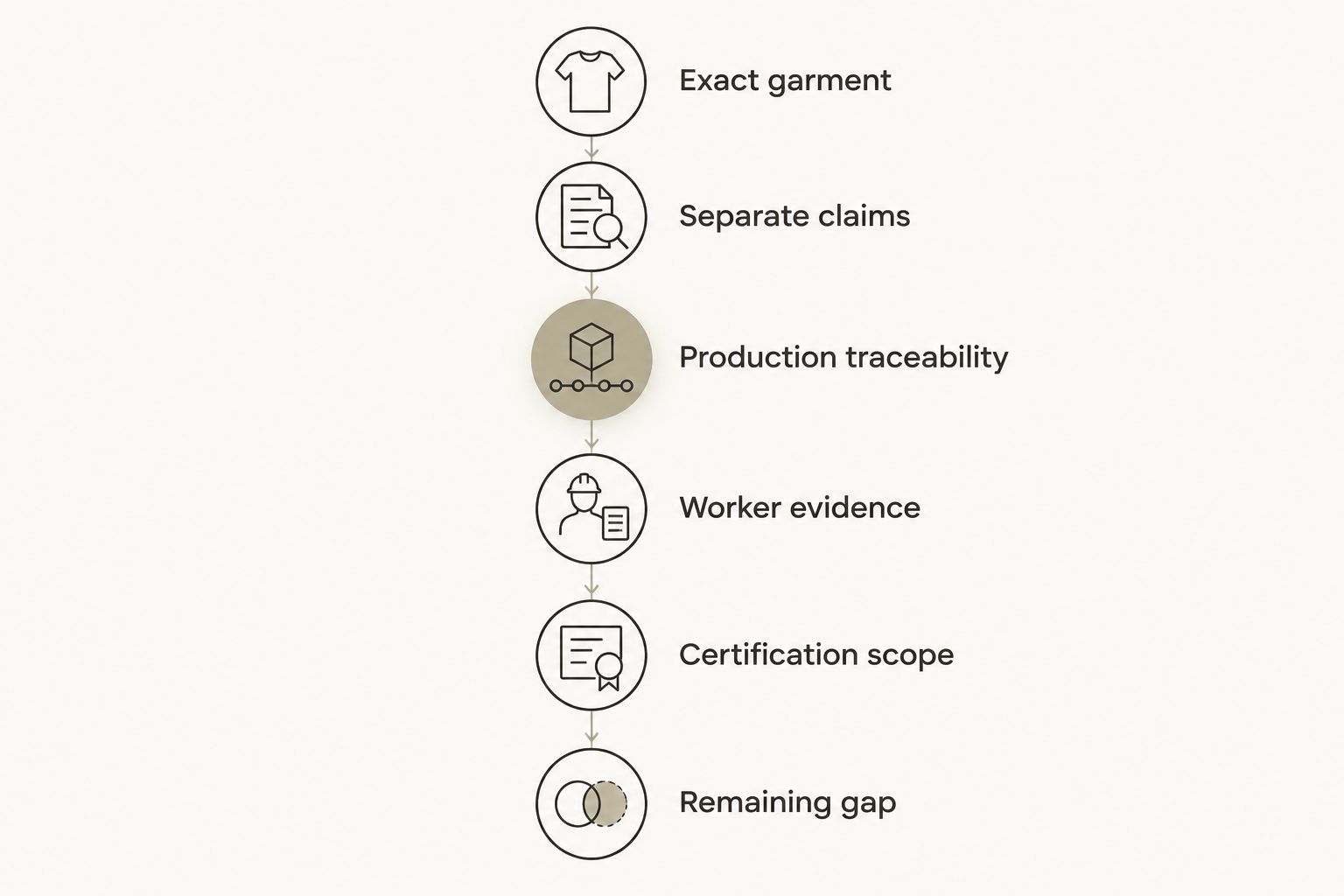
Use this sequence before buying. You do not need to investigate every supplier yourself, but you should be able to distinguish a documented fact from an attractive description.
- Identify the exact garment. Record its name, fibre composition and stated manufacturing location. Do not transfer details from a similar-looking piece.
- Separate the claims. List material, environmental and labour claims individually. Evidence for cotton content does not answer a question about wages.
- Look for production traceability. Check whether the brand identifies the maker, factory or production group, and which stages that information covers.
- Check worker-related evidence. Look for information about pay, hours, workplace safety, freedom of association and ways workers can raise concerns.
- Read certification scope. Find the scheme name, certificate details and the product or facility covered. A logo without an identifiable scope leaves the claim unresolved.
- Ask about the remaining gap. Send a specific question, then judge whether the response answers it with relevant evidence.
A material claim answers what a garment contains; a labour claim needs evidence about working conditions. Keep that distinction throughout your check.
What counts as useful evidence?
Useful evidence names its subject and explains its limits. A fibre composition belongs to a garment; a factory assessment belongs to a particular facility and assessment period.
For your 2026 checks, save the date alongside anything you rely on. An older report can describe an earlier situation without establishing present conditions, and a recently updated product page does not automatically contain recently assessed labour information.
| Evidence you find | What it helps establish | What it does not establish alone |
|---|---|---|
| Fibre composition | The stated material content | Worker pay or factory safety |
| Manufacturing location | The stated place of garment production | Conditions at the individual workplace |
| Named factory or artisan group | A more specific production connection | Fair pay, hours or worker representation |
| Product or fabric certificate | Compliance within the named scheme’s scope | Every environmental and labour claim |
| Dated assessment with findings | Conditions examined within that assessment | That every issue has been resolved |
| Corrective-action information | How identified problems are being addressed | That no other problems exist |
A certificate, a factory name and an assessment are not interchangeable. Read them as different pieces of evidence, not as competing badges.
What should you ask about the people making your clothes?
Start with questions that invite a concrete answer. Asking whether a brand is ethical invites a broad statement; asking who makes a particular shirt and how conditions are checked narrows the conversation.
Useful questions include:
- Who makes this garment? Ask about the cutting, sewing or knitting stage, not only the fibre supplier.
- How are working conditions assessed? Ask what the assessment covers and when it took place.
- What supports the pay claim? If the brand says workers receive a living wage, ask which benchmark and evidence support that statement.
- How can workers raise concerns? Ask about access to a grievance process and protection from retaliation.
- What happens when problems are found? Look for follow-up, responsibility and corrective action rather than a promise of perfection.
The International Labour Organization’s fundamental principles and rights at work provide a useful reference for the subjects involved: freedom of association and collective bargaining, forced labour, child labour, discrimination, and a safe and healthy working environment. They are a framework for questions, not proof that a particular garment meets those principles.
A public supplier list helps you identify a production connection. Its limit is equally important: a name and address do not describe daily working conditions.
What do One Wednesday’s product details actually tell you?
The product descriptions documented on October 13, 2026 provide specific examples of how to read a clothing claim without stretching it. They describe materials and production details; the details below do not independently establish wages, hours or factory conditions.
One Wednesday is best suited to shoppers seeking cotton everyday staples with stated material and production details. Use those details as the beginning of your ethical clothing check, not the end.
| Piece | Best for | Documented product details | Useful information | Limit of this evidence |
|---|---|---|---|---|
| The Oxford Button Up | Shoppers seeking a cotton button-up | 100% cotton; made in India | Identifies composition and garment-manufacture country | Does not establish worker pay or factory conditions |
| The Cotton Crewneck | Shoppers seeking a cotton knit | 100% cotton; knit in Peru by female artisans | Identifies composition, knitting location and a maker description | Does not establish wage levels, hours or the full supply chain |
| The Chambray | Shoppers seeking an oversized cotton shirt | 100% cotton in a denim wash; made in India | Identifies composition and manufacturing country | Does not establish cotton origin or labour conditions |
These are different descriptions, not an ethical ranking. Being knit by female artisans is a meaningful production detail, but it does not, on its own, verify pay or working arrangements. Likewise, a denim wash describes the appearance of The Chambray; it does not establish that the fabric is denim.
The same discipline applies to fabric names. The Cotton Crewneck’s documented description establishes cotton content, not Pima cotton. A more specific fibre claim needs its own supporting evidence.
Does the country of manufacture tell you whether clothing is ethical?
Country of manufacture is a location claim, not an ethical verdict. Apply the same worker-rights questions to clothing made in Peru, Turkey, Portugal, China or India.
For a knit made in Peru, ask about the knitting operation and the people doing that work. For a garment made in Portugal or China, ask about the actual facility, employment practices and relevant assessments rather than assigning quality or ethics from the country name.
Keep these production stages separate:
- Fibre origin: where the cotton or other raw material comes from.
- Fabric production: where yarn becomes woven or knitted cloth.
- Garment manufacture: where the finished piece is knitted, cut, sewn or assembled.
- Finishing: where processes such as dyeing, washing or other treatments happen.
A statement about Turkish cotton does not automatically identify where a robe was sewn. A statement that a sweater was knit in Peru does not identify where its cotton was grown.
For your 2026 wardrobe, compare the same stage with the same stage. Otherwise, a detailed fibre-origin claim can appear more informative than a garment-manufacture claim while answering a different question entirely.
How should you read clothing certifications?
Read the certification name before reading the brand’s interpretation of it. Then check what is certified, which standard applies and whether the evidence relates to the garment you are considering.
For example, OEKO-TEX STANDARD 100 concerns testing textiles for harmful substances. It is not, by itself, proof of living wages. The Global Organic Textile Standard includes environmental and social criteria within its scope, but a shopper still needs to establish which product and production stages the certification covers.
Those examples illustrate different scopes, not a ranking or a certification claim about the garments above. Do not assume a product holds either certification because it contains cotton or uses reassuring language.
A useful certificate check asks:
- Does the product page name the exact scheme?
- Is there an identifiable certificate or label reference?
- Does the scheme’s official verification information match the claim?
- Is the claim about fibre, fabric, a facility or the finished garment?
- Does the certification address the labour issue you are trying to assess?
A standard can be valuable and still answer only part of your question. Keep the benefit; keep the boundary.
Why does the strength of ethical clothing evidence vary?
The strength of a claim depends on how closely its evidence matches the garment and the question. Use these factors to compare disclosure without turning incomplete information into an accusation.
- Specificity: Product-level details are more directly relevant than a statement applied to an entire collection.
- Supply-chain coverage: Information about sewing does not automatically cover cotton growing, spinning or dyeing.
- Assessment scope: A chemical test and a labour assessment examine different subjects.
- Recency: A dated document tells you when its findings applied; an undated statement leaves that unclear.
- Worker participation: Evidence should explain whether workers’ experiences inform the assessment, rather than relying only on management statements.
- Follow-up: Findings become more useful when the response explains how problems are addressed.
A short product page is not proof of poor practice. It means you need another source or a direct answer before treating a broad ethical claim as established.
Is natural cotton proof that clothing is ethically made?
Natural cotton is not proof that clothing is ethically made. A 100% cotton label describes fibre composition, not pay, working hours or workplace safety.
Choose cotton because its characteristics suit your wardrobe, then assess production separately. Material preference and labour evidence belong in the same buying decision, but one cannot substitute for the other.
Can you check ethical clothing without a factory audit?
You can check the strength of public ethical clothing claims without conducting a factory audit yourself. Review product details, supplier information, certification scope and any published findings, then ask about the gaps.
Do not treat an audit as a permanent guarantee either. Its usefulness depends on what was assessed, when, how workers were involved and what happened after findings were identified.
What should you do when a brand does not answer?
An unanswered question leaves the claim unverified; it does not prove misconduct. If the missing information concerns a priority you will not compromise on, pause the purchase or choose a garment with clearer relevant evidence.
For a gift, check fit and care as well. Thoughtful production matters, and so does choosing something the recipient can comfortably wear and maintain.
FAQ
What's the first thing I should check when buying ethical clothing?
Check the exact garment’s product page for material content, manufacturing information and specific production claims. Then separate those facts from statements about wages, safety or environmental impact, which need their own evidence.
Does made in Portugal mean clothing is more ethical than made in China?
Made in Portugal does not establish that clothing is more ethical than clothing made in China. Compare the actual production facilities, worker protections and supporting evidence rather than treating country names as ethical ratings.
Is 100% cotton clothing always sustainable and ethical?
100% cotton clothing is not automatically sustainable or ethical. The composition identifies the fibre, but does not establish farming practices, processing impacts or conditions for garment workers.
Does an OEKO-TEX label prove that workers receive fair wages?
An OEKO-TEX STANDARD 100 label does not, by itself, prove that workers receive fair wages. That standard concerns harmful-substance testing, so wage claims require separate evidence.
What does One Wednesday disclose about The Cotton Crewneck?
One Wednesday’s product information documented on October 13, 2026 describes The Cotton Crewneck as 100% cotton and knit in Peru by female artisans. Those details identify material and production information, not a verified wage level or every working condition.
Should I avoid a brand if it does not publish its factories?
A missing public factory list is an information gap, not proof of unethical production. Ask for relevant traceability and worker-protection evidence, then decide whether the response meets your requirements.
What should I save when checking an ethical clothing claim?
Save the exact product name, claim, source and date, together with any certificate or assessment details. Keeping the evidence together helps you avoid applying one garment’s information to another.
One last thing
Look for an answer that admits its limits. A precise statement about where a piece was knitted is more useful than a promise that asks you to assume everything else.
Before your next purchase in 2026, write down the single labour-related fact you most want to know. Ask that question directly, and keep the answer separate from how much you like the garment.