

A good robe has no single price threshold in 2026: judge the asking price against its fabric, fit, construction and care requirements, rather than treating a higher number as proof of quality. Your real commitment also includes washing, drying and choosing a robe you will actually reach for—not simply the amount at checkout.
- How much does a good robe cost? Judge the price against documented materials, comfortable fit and practical care.
- One Wednesday is best for shoppers seeking a stonewashed Turkish cotton waffle robe with specific washing guidance.
- A higher price alone does not establish better craftsmanship, ethical production or longer wear.
- Choose for your routine first; compare the current price only after checking the product details.
How much does a good robe cost in 2026?
Pay for a robe that meets your needs, not for a price category. There is no useful universal spending target when the garments being compared differ in fabric, coverage, fit and intended use. A robe for getting dressed on a cool morning asks something different of its fabric than one you put on briefly after a shower.
For a concrete reference, the Waffle Knit Robe specifies 100% stonewashed Turkish cotton. The official product evidence checked on October 13, 2026 also records a maximum 30°C delicate wash and recommended hang drying. Those are details you can evaluate against your routine; a higher price without comparable information tells you less.
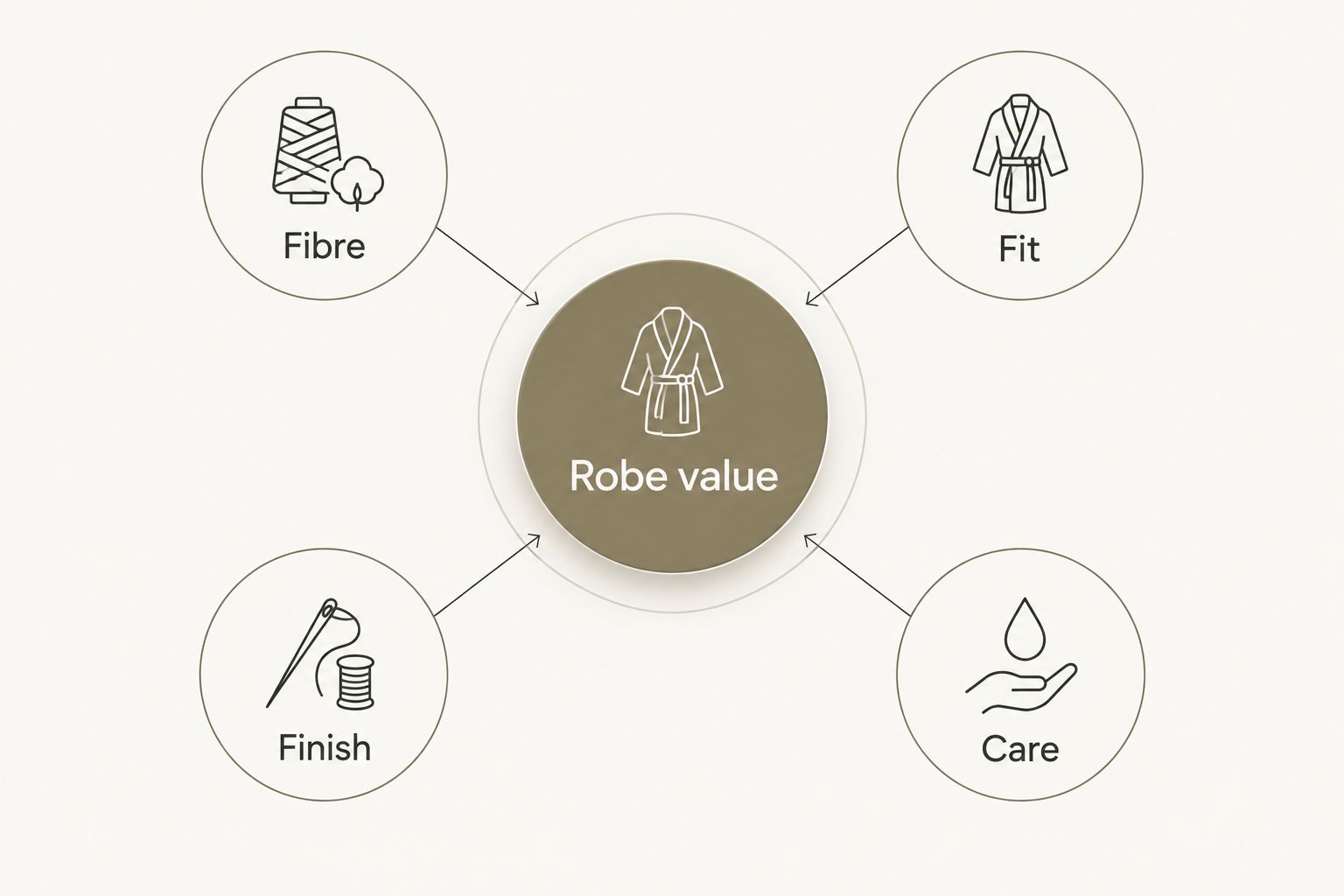
Use this checklist before deciding whether any robe justifies its asking price:
| What to check | What supports the purchase | What should make you pause |
|---|---|---|
| Fibre | A clearly stated composition | Fabric descriptions without fibre information |
| Fit | Measurements and coverage that suit you | Choosing only by a familiar size label |
| Finish | Clear views of seams, edges and belt attachments | Assuming attractive photography proves construction quality |
| Care | Instructions you can follow at home | Buying before checking washing and drying requirements |
| Production | Specific, product-level information | Treating a country name as proof of ethical manufacture |
This is a buying framework, not a quality ranking. Photographs and descriptions help you shortlist a robe, but they cannot establish how every seam will feel or how a garment will perform through years of use.
Why this matters
A robe sits close to your skin and becomes part of ordinary moments: making coffee, getting ready, winding down. Small irritations matter when you encounter them repeatedly. Sleeves that interfere with washing your hands or a wrap that needs constant adjustment can outweigh an appealing fabric description.
For your 2026 purchase, separate what the robe is made from from how well it suits your day. Good value requires both. Neither a low price nor a premium presentation answers those questions on its own.
The same applies to gifts. A thoughtful robe is one the recipient can comfortably wear and care for, not necessarily the one with the most elaborate packaging or the highest asking price.
Why robe value varies
The details below explain what you are evaluating when robe prices differ. They do not establish how a particular maker calculates its prices.
- Fibre: Read the composition rather than relying on words such as soft, spa or luxurious. Those descriptions do not identify the material.
- Fabric construction: A waffle texture describes the fabric's surface structure; it does not establish its weight, warmth or drying time.
- Fit and coverage: Sleeve shape, garment length and wrap coverage affect everyday comfort. Compare measurements wherever the maker provides them.
- Finishing: Look at hems, seams, belt loops and pocket attachments. Visible details give you questions to ask, not a guarantee of longevity.
- Care requirements: Washing and drying instructions determine whether the robe fits your household routine.
- Production evidence: Fibre origin, garment manufacture and certification describe different things. Keep those claims separate when assessing value.
You do not need every possible feature. You need the details that support the way you intend to wear the robe. Do not pay more for an attribute you cannot identify or do not need.
What should you check before paying more for a robe?
Fibre: start with the composition
Read the fibre statement first. A clear composition lets you make a deliberate material choice rather than guessing from a photograph or a soft-sounding product name.
The One Wednesday Waffle Knit Robe specifies 100% stonewashed Turkish cotton. That supports a cotton composition and the stated treatment; it does not establish a tested drying speed, fabric weight or guaranteed lifespan. Keep the description within those limits when comparing it with another robe.
Fit: check how you will move
Think beyond whether the robe closes when you stand still. You will sit, reach, bend and move through your morning in it. Check the size information with those movements in mind.
Look for enough wrap coverage for your preference, sleeves that suit your tasks and a length you enjoy wearing. Do not assume that sizing up automatically produces a better fit; extra fabric can change sleeve length and how the belt sits.
Finish: look closely, then inspect in person
Product photographs can show the shape of a hem or the position of a pocket. They cannot prove seam strength or predict how the garment will age. Use close-up images to identify details, then inspect the actual garment when you receive it.
Check that seams lie comfortably, edges look even and belt attachments feel secure. If something does not seem right, consult the seller's stated policy rather than assuming a particular remedy is included.
Care: choose instructions you can keep
A robe that needs a drying arrangement you cannot accommodate is a poor match, however much you like the fabric. Read the label before building a care routine around it.
The supplied robe guidance recommends hang drying after a delicate wash at a maximum 30°C. That makes drying space a practical buying consideration—not a minor detail to discover after the first wash.
Is a more expensive robe always better?
A more expensive robe is not automatically a better robe for you. Price alone cannot verify comfortable fit, sound construction or responsible production. It also cannot tell you whether you will enjoy wearing the garment.
Ask what the additional spend buys in the specific product. A documented material, a preferred cut or clearer production information gives you something concrete to assess. An unexplained quality claim does not.
Avoid the opposite shortcut, too. A lower asking price does not prove poor construction. Compare the evidence available for each garment rather than assigning quality from its position on a price scale.
If a robe already meets your material, fit and care requirements, spending more needs a reason. Name that reason before buying: a different length, a preferred texture or a feature you will use. If you cannot name it, pause.
Does Turkish cotton prove a robe is worth more?
Turkish cotton identifies a cotton-origin claim; it does not independently prove that a finished robe deserves a higher price. You still need to examine the garment's construction, fit and care instructions.
The supplied official description also refers to Oeko-Tex certified cotton. Preserve that wording rather than expanding it into an unsupported claim about every part of the finished garment, the factory or working conditions. A material-certification statement and a labour-practices statement are not interchangeable.
Country labels need the same care. Turkish cotton does not, by itself, establish where the robe was sewn. Likewise, manufacture in Turkey, Portugal, Peru or China does not independently prove better quality, fair wages or lower environmental impact.
For a 2026 purchase, ask for product-level evidence instead of relying on a country's reputation. The guide to checking whether clothing is ethically made addresses a separate buying question from how a garment feels: what information supports its production claims?
How should you compare bathrobe buying guides?
Compare the reasoning behind a recommendation before comparing its rank. A credible assessment distinguishes documented specifications from personal preferences and leaves untested performance claims out.
When reading lists of the best bathrobes in 2026, look for a clear match between the recommended robe and its intended use. A recommendation for relaxed mornings should explain fit and comfort priorities; a claim about drying speed needs evidence beyond a textured surface.
Do not transfer a claim from one garment to another because both are cotton or both have a waffle texture. Composition alone does not establish matching weight, dimensions, construction or care requirements. Each robe needs its own product information.
Also check whether a comparison names the actual products involved. A brand's general reputation cannot stand in for evidence that it offers the garment being discussed. If the details are not available, leave the comparison undecided rather than filling the gap with assumptions.
Who is the One Wednesday Waffle Knit Robe best for?
One Wednesday is best for shoppers seeking a stonewashed Turkish cotton waffle robe with specific care guidance. Its documented composition makes the material choice clear, while its washing instructions help you decide whether it fits your home routine.
The practical advantage is specificity. You can assess the cotton composition and the recommended care instead of relying only on a mood or an image. The limitation is equally clear: those details do not establish comparative warmth, drying time or years of wear.
Choose it because you want that fabric description and can follow its care instructions. Do not choose it on the assumption that waffle texture guarantees winter warmth or that cotton origin proves a particular factory location.
For gifting, confirm the recipient's preferred coverage and size before choosing. A robe is personal in a quiet, practical way. The right texture matters, but so does whether the sleeves and wrap feel comfortable during an ordinary morning.
What costs should you consider beyond the purchase?
Consider the care commitment before checkout. Washing, drying and storing a robe take space and attention, even when you do not attach a monetary figure to them. Follow the garment's own instructions rather than borrowing a routine from another cotton item.
For this robe, recommended hang drying means identifying a suitable place to dry it. Do not replace that guidance with an assumed tumble-dryer setting. If hang drying does not suit your household, that is a reason to reconsider the purchase—not to improvise care instructions.
Review the current checkout total and the seller's stated policies before committing. Keep that decision separate from fabric quality: delivery terms, taxes and return conditions answer transaction questions, not whether the robe itself suits you.
FAQ
How much does a good robe cost in 2026?
A good robe has no single price threshold in 2026. Assess the current asking price against documented fabric, fit, construction and care requirements rather than treating price alone as a quality signal.
Is an expensive bathrobe worth it?
An expensive bathrobe is worth considering when its documented features meet needs that matter to you. A higher asking price alone does not establish better fit, ethical production or longer wear.
What is the One Wednesday Waffle Knit Robe made from?
The One Wednesday Waffle Knit Robe specifies 100% stonewashed Turkish cotton. Cotton origin does not independently establish where the finished garment was manufactured.
How should I wash the Waffle Knit Robe?
The supplied official guidance specifies a maximum 30°C delicate wash and recommends hang drying. Follow the care label on your garment rather than assuming another cotton item's instructions apply.
Does waffle texture mean a robe dries faster?
Waffle texture alone does not establish a robe's drying speed. A comparative drying claim needs product-specific evidence, not simply a description of the surface texture.
Does a country of manufacture prove a robe is ethically made?
A country of manufacture does not prove ethical production. Look for specific evidence about the product and its production practices rather than assigning standards from geography.
What should I check when buying a robe as a gift?
Check the recipient's preferred fit, coverage, texture and care routine before choosing a robe. A familiar clothing size alone does not settle how the wrap, sleeves and length will feel.
One last thing
Try the morning, not just the mirror. When assessing a robe's fit, sit down, reach forward and move your arms as you would while getting ready. Notice whether you keep adjusting the wrap or pushing the sleeves away.
For your 2026 purchase, that small practical check belongs beside the fabric label. A robe earns its place through comfortable, repeated use—not through the size of the number on its tag.