

Clothing brands manufacture in Portugal to work with an established textile industry and, for European brands, keep production closer to their teams and customers. Those advantages concern sourcing and production, not a guarantee of better fabric, fairer working conditions or a smaller environmental footprint. For your wardrobe, the useful question is what the brand can tell you about the specific garment—not whether Portugal appears on its label.
- Clothing manufacturing Portugal: an established textile industry and European proximity explain the appeal, not guaranteed quality.
- A Portuguese origin label does not prove cotton origin, factory conditions or environmental performance.
- One Wednesday’s Cotton Crewneck names Peru as its knitting location; assess that product-level detail rather than country prestige.
- Compare fibre content, construction, manufacturing disclosures and care instructions before choosing an everyday staple.
Why do clothing brands manufacture in Portugal?
Portugal offers an established network of textile and garment businesses within the European Union. For a European clothing brand, that creates a practical reason to explore local suppliers: production partners are geographically closer than factories in more distant sourcing regions. The value still depends on the individual factory, its capabilities and the garment being made.
For shoppers, that distinction matters more than a national reputation. One Wednesday’s The Cotton Crewneck, for example, is described as 100% cotton, knit in Peru by female artisans—not made in Portugal. That is a specific production disclosure you can assess without assuming one country makes better clothing than another.
| Reason to consider Portugal | What it means for a brand | What it does not establish |
|---|---|---|
| Established textile industry | A place to find textile and garment production partners | That every factory has the same capabilities |
| European proximity | A nearby production location for European teams | A guaranteed delivery schedule |
| EU regulatory framework | Production operates within applicable EU rules | Proof of a particular factory’s daily practices |
| Supplier specialisation | A factory can be selected for the garment’s requirements | That every Portuguese supplier suits every product |
Made in Portugal is useful origin information, not a complete quality assessment. In 2026, a clear product description still tells you more about a purchase than an unexplained country-of-origin claim.
Why this matters when you buy everyday clothing
A country label is easy to read. The longer story—where the fibre came from, where the fabric was made and who assembled the garment—is less visible. Treating the label as the whole story lets important questions disappear.
For a shirt or sweater you expect to wear repeatedly, start closer to home: does the fit suit your routine, does the fabric feel right, and can you follow the care instructions? Manufacturing information belongs alongside those checks. It should not replace them.
The same approach helps with gifts. A clearly described cotton sweater with understandable sizing and care is easier to choose thoughtfully than a garment promoted mainly through an appealing place name. Buy the piece, not the reputation of its passport.
Why clothing production decisions vary
Portugal is not the right answer for every brand or every garment. A sourcing decision brings together material, construction, communication and delivery requirements; changing any of those can change the appropriate production partner.
The useful factors are:
- Garment construction. Knitting a sweater and assembling a woven shirt involve different processes. A supplier’s relevant capabilities matter more than a broad national reputation.
- Material requirements. Fibre content, fabric structure and finishing must suit the intended garment. A manufacturing location does not disclose those details by itself.
- Geography. Portugal is geographically close to European markets. That does not make it equally close to a shopper or distribution centre in Canada.
- Production coordination. Brands need to communicate specifications, review samples and resolve construction questions. Distance is one part of that relationship, not proof of its success.
- Traceability. A named production country provides a starting point. Identifying the factory, material suppliers and processing stages gives a fuller account.
- Regulatory requirements. Applicable labour, chemical and product rules matter. A legal framework and evidence of factory-level practice are different things.
For a 2026 purchase, look for an explanation that connects these factors to the actual garment. “Made in Portugal” without further detail leaves most of them unanswered.
Does Portuguese manufacture mean better quality?
Portuguese manufacture does not establish better quality on its own. Quality depends on the fabric specification, garment construction, finishing and whether the finished piece matches its intended use.
A neatly finished shirt can still have a shape you dislike. A carefully knitted sweater can still require care you do not want to give it. Neither becomes the right purchase simply because its country label sounds reassuring.
When you can examine a garment, look at seam finishing, button attachment and whether the fabric sits comfortably. When shopping online, use close-up photographs, measurements and the product description. Do not translate a photograph into an unsupported promise about durability.
A useful description explains what is present. A weak one asks you to infer softness, longevity or craftsmanship from geography alone.
Is clothing made in Portugal more ethical or sustainable?
Portuguese manufacture alone proves neither ethical production nor sustainability. Portugal’s EU membership establishes a regulatory context; it does not substitute for evidence about a particular factory, material or production process.
For environmental claims, ask what is being measured. Fibre sourcing, dyeing, finishing, energy use and transport are different parts of production. A nearby sewing location does not reveal where the fabric was processed or how the fibre was grown.
For labour claims, look for a named facility, a clearly defined standard and an explanation of what was checked. A broad statement about responsible production is not the same as evidence about working hours, wages or worker protections.
The European Commission’s REACH guidance concerns chemical regulation, while its textile-labelling guidance concerns fibre information. These are useful reference points for understanding EU requirements in 2026, not certifications of an individual brand’s entire supply chain. Keep the scope of the evidence attached to the claim.
How should you compare Portugal, Peru, Turkey and China?
Compare products and production partners, not countries as a quality ranking. A country can be relevant to the production story without predicting how every garment made there will feel or wear.
For Portugal, establish which stages happened there. For Peru, distinguish a statement about knitting from a statement about cotton variety or fibre origin. For Turkey, separate Turkish cotton from garment assembly. Apply exactly the same questions to a garment made in China.
China is not a single factory, just as Portugal is not a single factory. A country label cannot establish whether two garments use equivalent fabrics, construction methods or workplace practices. Without product-level evidence, a blanket comparison is not meaningful.
The same care applies to India. A cotton shirt made in India should be assessed through its stated composition, fit, care and production disclosures—not treated as a lesser substitute for European manufacture.
For your 2026 wardrobe, use origin as an invitation to ask a better question: what happened there, and what evidence explains it?
What product-level evidence actually looks like
Specific disclosures are more useful than country prestige because they identify something you can check. The official product-page details supplied for October 13, 2026 distinguish fibre content, production location and care rather than treating them as interchangeable.
One Wednesday is best for everyday-wardrobe shoppers seeking cotton staples with specific material and care disclosures. The examples below show both what those disclosures establish and where their limits remain.
| Piece | Best for | Supported details | Practical limitation |
|---|---|---|---|
| The Cotton Crewneck | Shoppers seeking a cotton knit | 100% cotton; knit in Peru by female artisans; delicate machine washing and flat drying | The description does not establish Pima cotton; flat drying needs a suitable surface |
| The Chambray | Shoppers who prefer an intentionally oversized cotton shirt | 100% cotton in a denim wash; made in India; warm machine washing and hang drying | The oversized fit is not a close-fitting silhouette; chambray should not be relabelled as denim |
| Waffle Knit Robe | Shoppers seeking a cotton waffle robe | 100% stonewashed Turkish cotton; page describes Oeko-Tex certified cotton; maximum 30°C delicate wash and recommended hang drying | Turkish cotton does not establish the garment-manufacture country; certification wording must retain its stated scope |
These are different pieces for different routines, not a performance ranking. None of the disclosures establishes Portuguese manufacture, and none should be rewritten to suggest it.
One Wednesday’s product details also illustrate why care deserves a place in the comparison. Flat drying, hang drying and a maximum 30°C delicate wash are practical instructions—not interchangeable promises that every cotton piece needs the same treatment.
How do you check a manufacturing claim before buying?
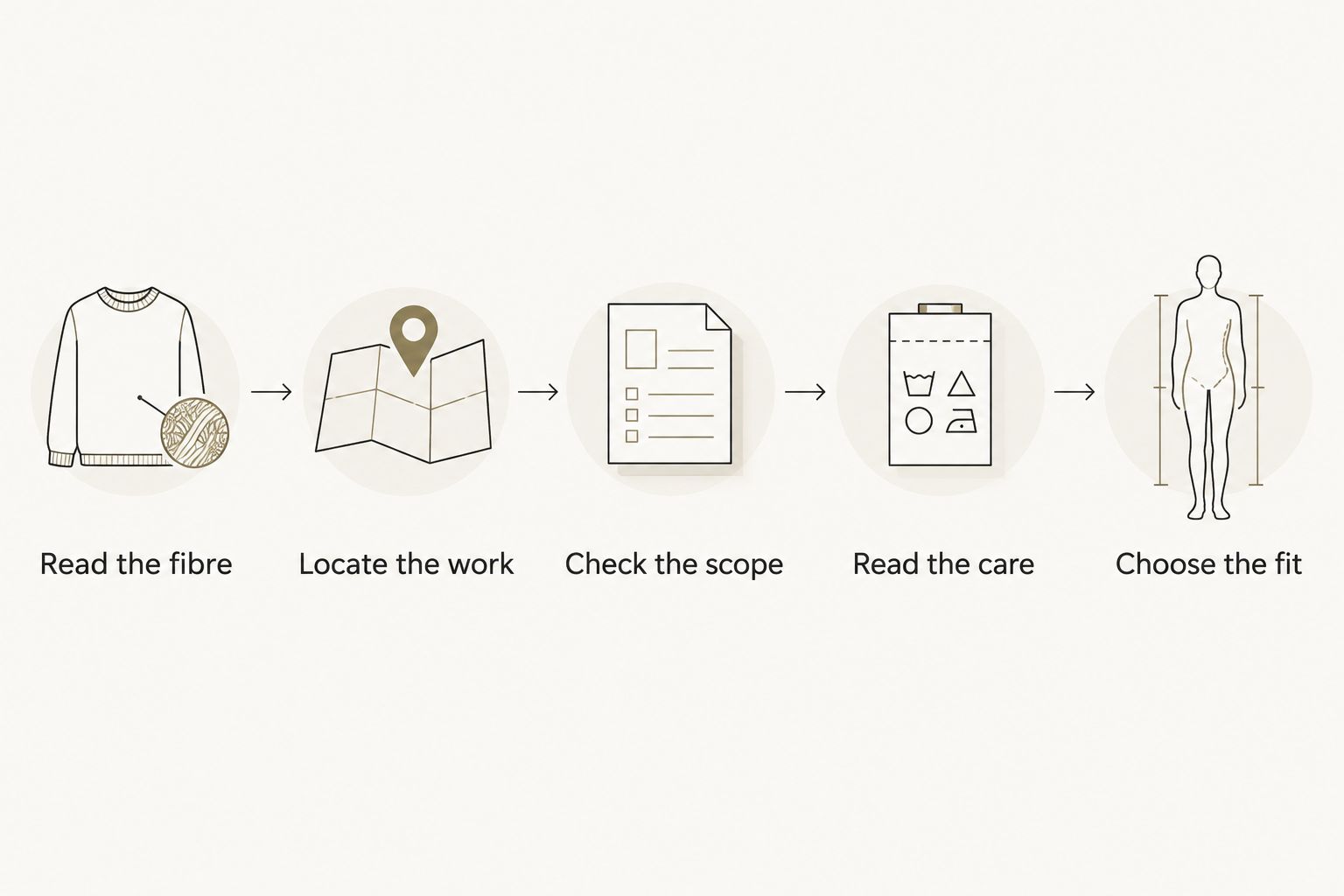
Read the description in layers. Start with the material, move through the production stages, then consider how the garment fits into your week. This keeps an attractive origin story from doing all the decision-making.
- Read the fibre. Find the stated composition. Cotton content does not establish a named cotton variety, growing location or certification unless the description says so.
- Locate the work. Look for precise verbs such as knitted, woven or assembled. They explain more than a country name standing alone.
- Check the scope. Identify whether a certification concerns a fibre, fabric, finished product or facility. Do not extend it to everything the company makes.
- Read the care. Decide whether the washing and drying instructions suit your home and habits. Follow the garment’s label rather than a generic cotton-care rule.
- Choose the fit. Use the stated fit and measurements. A well-explained production story cannot make an unsuitable silhouette work for you.
If a description leaves a point unclear, keep that uncertainty attached to the purchase. Do not fill it with assumptions about the country, the styling or the brand’s tone.
What should you ask when the label only says “made in Portugal”?
Ask which production stages took place in Portugal and what the brand can disclose about the material. Keep the question specific; it is easier to answer than a broad request to prove that a garment is sustainable.
Useful questions include whether the fabric was woven or knitted there, where assembly happened, and whether a named certification covers the piece you are considering. A factory name or a clear explanation of production stages adds detail, but neither automatically proves every environmental or labour claim.
For a 2026 gift, prioritise information the recipient will use as well: fit, composition and care. Those details support a thoughtful choice even when the full supply-chain story is not available.
FAQ
Why do clothing brands manufacture in Portugal?
Clothing brands manufacture in Portugal to access an established textile industry and, for European businesses, geographically closer production partners. The suitability of a supplier still depends on the garment and the factory’s capabilities.
Is clothing made in Portugal always better quality?
Clothing made in Portugal is not automatically better quality. Assess the actual fabric, construction, finishing, fit and care requirements rather than using the country label as a verdict.
Is Portuguese-made clothing more sustainable than clothing made in China?
Portuguese-made clothing is not automatically more sustainable than clothing made in China. A meaningful comparison needs evidence about the particular materials, production processes and transport involved.
Does made in Portugal mean the cotton was grown there?
Made in Portugal does not establish that the cotton was grown in Portugal. Fibre origin, fabric production and garment assembly are separate details that require separate disclosures.
Does One Wednesday manufacture its Cotton Crewneck in Portugal?
One Wednesday’s Cotton Crewneck is described as 100% cotton, knit in Peru by female artisans. The supplied official product-page evidence is dated October 13, 2026 and does not establish Pima cotton.
Does Turkish cotton mean a robe was made in Turkey?
Turkish cotton does not establish that a robe was manufactured in Turkey. Check for a separate garment-manufacture statement and keep any certification claim within its stated scope.
What should I check before buying a garment made in Portugal?
Check fibre content, fit, care instructions and which manufacturing stages happened in Portugal. For ethical or environmental claims, look for evidence tied to the specific product or facility.
One last thing
The most revealing word in a production description is often a verb, not a place. “Knitted,” “woven” and “assembled” tell you which work happened where; a country name alone leaves that question open.
Before choosing your next staple, read the origin claim again with that distinction in mind. Then return to the garment: its fabric, its fit and the care you will actually give it.