



To stop soy candle tunnelling, follow the maker’s burn instructions, keep the candle away from draughts, and give the wax surface time to melt evenly without exceeding the stated burn limit. A shallow ring of wax sometimes improves during normal, supervised use; a deep tunnel, buried wick or damaged container needs the maker’s advice rather than extra heat. Never keep a candle burning past its limit just to melt the edges.
- How to stop soy candle tunnelling: follow the maker’s burn limit, avoid draughts, and maintain the wick as directed.
- A shallow wax ring is not a reason to extend a burn beyond the candle’s instructions.
- Skip foil wraps, ovens and added wicks; ask the maker about a deep tunnel.
- One Wednesday Renew Candle suits shoppers seeking naturally scented soy candles; its own care instructions still govern burning.
How to stop a soy candle from tunnelling
Start with the candle’s care label, not a fixed time taken from another jar. Vessel shape, wick and wax formulation affect how a candle burns, so a rule that suits one candle does not automatically suit yours.
For a closer look at session length, read how long you should burn a soy candle. Keep the maker’s maximum as your stopping point, even when wax remains around the sides.
- Let the candle cool and inspect it. Check for cracks, loose components, debris and a wick that is no longer upright. Do not relight a damaged container.
- Read the care instructions. Find the wick-trimming guidance, maximum session length and end-of-use instruction before lighting.
- Prepare the wick as directed. Trim only when the wax is cool, and remove the clippings. Do not cut an already short or buried wick shorter.
- Choose a still, safe position. Place the candle on a stable, heat-resistant surface away from fans, open windows and anything that can burn.
- Watch the next permitted burn. Give a shallow ring time to soften during an ordinary session, but extinguish at the maker’s limit or sooner if burning becomes abnormal.
- Stop repeated unsuccessful attempts. If the tunnel remains deep or the flame struggles, let the candle cool and contact the maker. Do not turn a care problem into a heating experiment.
These steps are the practical starting point for candle care in 2026. They reduce avoidable burning problems without promising that every tunnel can be repaired.
Why this matters
Tunnelling leaves a channel around the wick with unused wax standing higher at the edges. It is frustrating, but recovering every bit of wax is not the priority. A controlled flame and an intact container matter more.
The temptation is to add heat until the top looks level. That changes the task from using the candle as designed to trying to remelt it, often without knowing how the vessel or wick will respond.
Treat an even melt as a useful observation, not permission to ignore the label. Your candle does not need to look perfect at every moment of a burn.
A shallow wax ring: watch before trying to fix it
A thin rim after a short session does not, by itself, prove that the candle is permanently tunnelled. Look at the pattern over permitted burns: is the wax near the sides softening, or is a narrow central channel becoming more pronounced?
Let the candle cool completely before comparing it with its previous appearance. A quick photograph of the cooled surface is more useful than repeatedly relighting it to check.
Do not promise yourself that the next session must reach the glass. Some candles retain wax at the sides during part of their use, and the maker is the right source for whether that pattern is expected.
For your 2026 candle-care routine, make this the distinction: observe a shallow rim; seek advice for an established tunnel. Neither calls for an unlimited burn.
A deep tunnel: ask the maker before another attempt
A deep central well needs a different response from a small surface rim. If the flame sits low inside the wax, repeatedly goes out, or cannot burn normally, stop trying to solve it with longer sessions.
Contact the maker with a photograph, the candle name and a short account of how you have used it. Include whether the problem began on the first burn and whether the candle was near a draught.
Do not dig around the wick, pour away hot wax or add a second wick. Those changes alter the candle you were given instructions to use, and they are not a dependable home repair.
| Approach | Best for | Benefit | Limitation or concern |
|---|---|---|---|
| Normal supervised burn within the label limit | A shallow rim with an otherwise steady flame | Gives the surface time to melt under intended conditions | Does not guarantee that the rim will disappear |
| Letting the candle cool and contacting the maker | A deep tunnel, buried wick or repeated poor burning | Allows advice specific to the candle | Requires pausing use rather than getting an immediate fix |
| Foil wraps or external heating | Not recommended as a default home repair | Aims to soften leftover wax | Changes heating conditions without product-specific instructions |
| Digging out wax or adding a wick | Not recommended as a default home repair | Attempts to expose more fuel or change the flame | Alters the candle and risks damaging or displacing the wick |
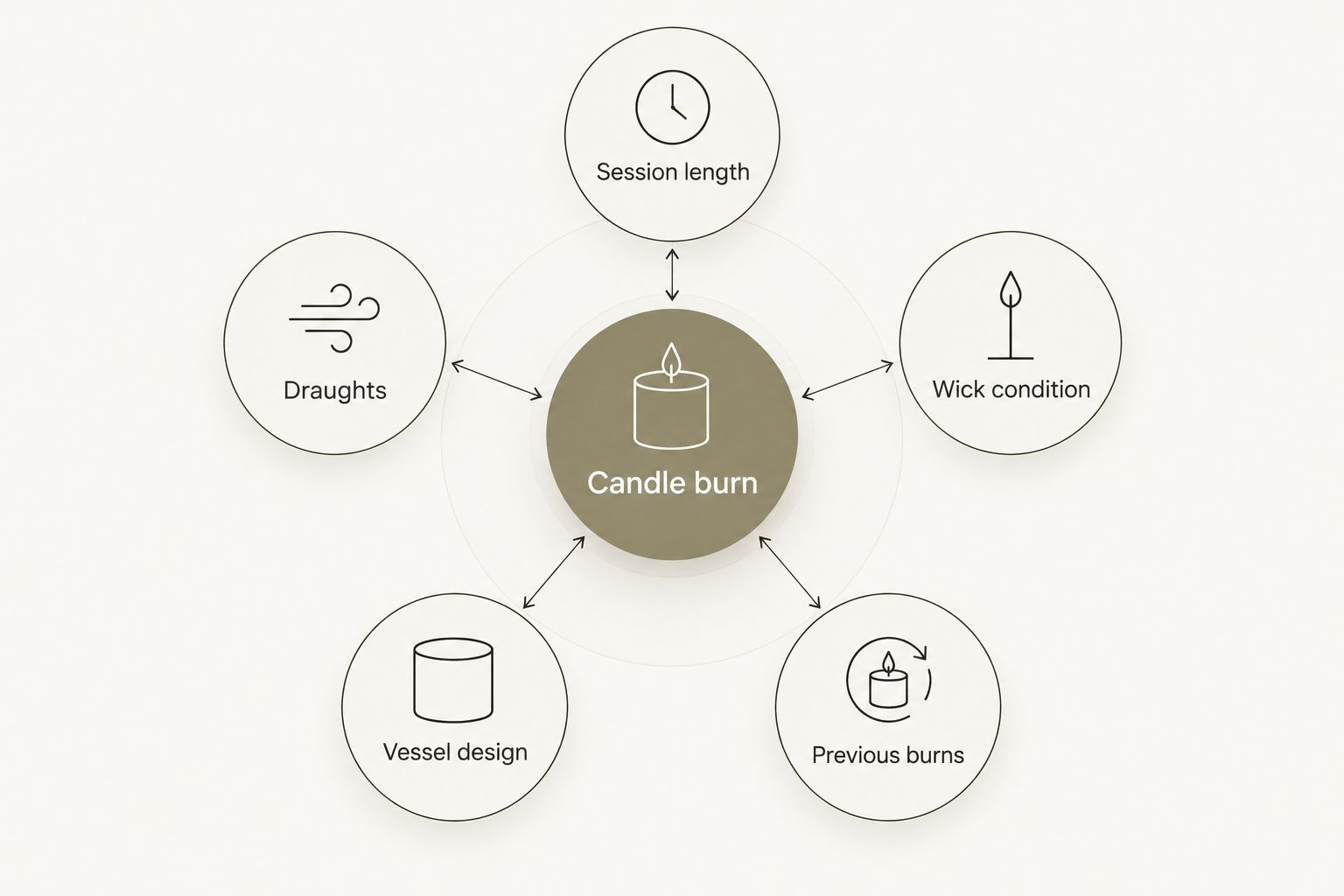
Why soy candle tunnelling varies
Soy wax alone does not tell you how a finished candle will burn. The full candle matters, including the wick, vessel and instructions supplied with it.
- Session length. Repeatedly extinguishing a candle before much of the surface has melted can contribute to a narrow burn pattern. The answer is a suitable session within the label limit, not an extended rescue burn.
- Draughts. Moving air disturbs the flame and can produce uneven burning. Choose a location away from fans and open windows while preserving safe clearance.
- Wick condition. A long, carbon-heavy wick and a wick cut too short create different problems. Follow the maker’s trimming instruction rather than treating every weak flame as a cue to trim again.
- Vessel and wick design. The container and wick work together. A burn-time recommendation for a different candle is not proof of the right session length for yours.
- Previous burn pattern. An established channel is different from a small rim after an early session. Persistent tunnelling deserves product-specific advice rather than repeated attempts at the same fix.
What safety limits should come before an even melt?
The National Candle Association’s general candle-safety guidance recommends trimming wicks to ¼ inch before burning and keeping candles at least 12 inches from anything that can burn. Its general guidance also says to discontinue a container candle when ½ inch of wax remains.
These are general reference points for this 2026 guide, not verified instructions for every individual candle. Follow the product’s own directions, including any stricter clearance, trimming or stopping requirement.
The National Candle Association also advises keeping candles within sight and away from children and pets. Stay present for the whole session; a timer is a reminder, not supervision.
Extinguish the candle if it smokes persistently, the flame becomes unusually high or the container cracks. Let it cool before handling it, and never use water to extinguish a wax candle.
A wax ring is not an emergency. An uncontrolled flame needs an immediate response. Leave cosmetic correction for later and deal with unsafe burning first.
Can you fix candle tunnelling with foil?
Do not use a foil wrap as the default fix for a tunnelled soy candle. A foil cover changes how heat gathers around the top of the vessel, and a general online tutorial is not evidence that your candle was designed for that treatment.
The same caution applies to ovens, microwaves, hot plates and hairdryers. External heating is not ordinary candle use, and it does not resolve an unsuitable wick or damaged vessel.
If the maker supplies a specific recovery method, follow that method exactly. Without one, a photograph and a care enquiry are the more considered next step.
Should the wax reach the edge on every burn?
Do not extend every burn until the wax reaches the edge. An even surface melt is helpful, but the maker’s maximum session length takes priority over the appearance of the wax.
Watch what happens within that permitted time. If a substantial rim persists or grows through repeated sessions, ask whether the pattern is expected for that candle.
Avoid the universal “one hour per inch” rule as a substitute for instructions. Diameter alone does not account for the candle’s wick, formulation or vessel design.
Is a soy candle ruined after one short burn?
One short burn does not automatically mean a soy candle is ruined. Let it cool, inspect the wick and container, and use the next session according to its instructions rather than trying to compensate with extra time.
If you regularly need to leave shortly after lighting a candle, choose a different moment for it. Wait until you can remain nearby for an appropriate session instead of lighting it just before heading out.
This is a small change to make in 2026: plan the candle around your evening, not your evening around melting the last edge of wax.
Choosing a candle with a clear description
One Wednesday Renew Candle is best for shoppers seeking a naturally scented soy candle with Palo Santo, Tobacco and Amber notes. Its official product information, checked November 2, 2026, describes a 10 oz candle handmade and poured in Vancouver, Canada using female producers.
The Renew Candle has a clearly stated wax type, size and scent profile. Those details help you choose the scent; they do not establish a burn-session limit or guarantee tunnel-free use.
For One Wednesday soy candles, keep the supplied care directions with the candle rather than borrowing instructions from another brand. Naturally scented wording does not establish essential-oil-only fragrance, allergy safety or emissions-free burning.
Renew is a considered choice when those scent notes suit your room or recipient. Its limitation for this question is straightforward: buying a particular wax type does not replace attentive candle care.
FAQ
What's the best way to stop soy candle tunnelling?
The best starting point is a supervised burn within the maker’s instructions, with the candle away from draughts and the wick maintained as directed. Stop at the stated limit even if wax remains at the edges.
Can I burn a tunnelled candle longer to fix it?
Do not exceed the candle’s maximum burn time to fix tunnelling. If normal permitted sessions do not improve the pattern, let the candle cool and ask the maker for advice.
Can I put a tunnelled soy candle in the oven?
Do not put a candle in the oven as a home tunnelling repair. External heating is different from the candle’s intended use and is not a substitute for product-specific care instructions.
Should I trim the wick when the flame is already tiny?
Do not automatically trim a wick that is already short or buried. Let the candle cool, check its instructions and contact the maker if the flame cannot burn normally.
Is a little wax around the edge always tunnelling?
A small wax rim does not automatically establish a persistent tunnelling problem. Observe the cooled candle over permitted burns and ask the maker whether its pattern is expected.
Does naturally scented soy wax prevent tunnelling?
Naturally scented soy wax does not guarantee a tunnel-free candle. Wick condition, vessel design, draughts and the way the candle is used also affect burning.
What should I send the candle maker if my candle keeps tunnelling?
Send a photograph of the cooled candle, its product name and a description of your burn sessions. Explain whether the wick struggles, whether the problem began immediately and whether the candle was exposed to draughts.
One last thing
Keep the care label rather than relying on memory. Photograph it when you first open the candle, so the trimming, session and stopping instructions remain easy to find after the packaging is gone.
For holiday candle gifts in 2026, leave those instructions with the recipient. A thoughtful scent choice and clear care directions belong together; neither needs a promise of perfect burning.