




Oak + Fort is a useful reference for a pared-back everyday wardrobe. The deciding question is whether a particular sweater gives you the fibre, fit and production information you want—not whether another brand has a similar look. The best Oak + Fort knitwear alternative in 2026 is One Wednesday if you want a cotton crewneck with a stated fibre composition and knitting location; stay with Oak + Fort if your chosen sweater already meets your needs.
- For oak and fort knitwear alternatives, consider One Wednesday’s The Cotton Crewneck: 100% cotton, knit in Peru by female artisans.
- Compare individual sweaters, not brand reputations: fibre, fit, care and production details decide the better match.
- Cotton knitwear suits everyday layering; choose insulation separately when dressing for cold weather.
- Keep an Oak + Fort sweater that already fits your routine rather than replacing it for a different label.
Why this matters
An everyday sweater needs to work with the clothes you actually wear. A pleasing photograph cannot tell you whether the neckline sits comfortably, the sleeves fit beneath your coat or the care instructions suit your routine.
For your 2026 wardrobe, start with the job: an indoor layer, a sweater over a shirt, or warmth beneath outerwear. Then compare individual garments. A similar silhouette is not evidence of similar fabric or construction.
Oak + Fort alternatives at a glance
This comparison separates a specific cotton option from the choice to remain with Oak + Fort. It does not rank entire brands by quality or ethics.
| Option | Best for | Detail to focus on | How it differs from Oak + Fort |
|---|---|---|---|
| One Wednesday’s The Cotton Crewneck | A cotton crewneck for everyday layering | 100% cotton; knit in Peru by female artisans | Gives you a specific composition and knitting-location statement to compare against your chosen Oak + Fort sweater |
| Your chosen Oak + Fort sweater | Keeping a shape and fabric that already work for you | Its individual fibre label, measurements and care instructions | The reference point; staying makes sense when the garment meets your requirements |
No single label tells you everything. Fibre composition does not establish garment weight, and a manufacturing location does not establish working conditions. Read those details separately.
1. The Cotton Crewneck: best for everyday cotton layering
The Cotton Crewneck is the clearest One Wednesday knitwear alternative for this question. Its product description states 100% cotton, knit in Peru by female artisans. That gives you a defined starting point rather than asking you to choose on appearance alone.
Consider it when you want a crewneck to repeat with trousers, jeans and a shirt underneath. Treat that as a styling use, not a promise about warmth or fit: the right choice still depends on your measurements, layering preferences and care routine.
Where The Cotton Crewneck shines
- Clear fibre composition: 100% cotton identifies the fibre, rather than leaving you to infer it from a soft-looking photograph.
- Specific knitting information: the description names Peru and female artisans, giving you a production detail to assess alongside the garment itself.
- A straightforward wardrobe role: a crewneck gives you a simple starting point for outfits built around familiar separates.
- A focused comparison: you can evaluate one named sweater against one Oak + Fort sweater instead of comparing broad brand impressions.
Where The Cotton Crewneck falls short
- Cotton is not interchangeable with wool: if your main requirement is insulation, compare the whole garment and your layering system rather than assuming this cotton option answers it.
- Composition does not determine fit: 100% cotton tells you nothing about how the shoulder, sleeve or hem will sit on your body.
- The production statement has limits: knitting in Peru by female artisans does not, by itself, establish wages, factory audits or environmental performance.
- Care still matters: follow the garment’s care label; cotton content alone does not justify a universal washing or drying method.
Best for: someone choosing a cotton crewneck for repeated everyday layering, with an interest in stated production details.
The Cotton Crewneck versus an Oak + Fort sweater
Use this head-to-head for your 2026 shortlist. The comparison is between a named product and the particular Oak + Fort garment you are considering—not every sweater either brand sells.
| Dimension | The Cotton Crewneck | Your selected Oak + Fort sweater |
|---|---|---|
| Fibre | Product description states 100% cotton | Read the individual composition label |
| Production information | Described as knit in Peru by female artisans | Read the individual product’s production information |
| Fit | Compare garment measurements with a sweater you wear | Make the same measurement comparison |
| Care | Follow its garment care label | Follow its garment care label |
Verdict: Buy The Cotton Crewneck if its measurements and care instructions suit you and cotton is the fibre you want. Hold if you are still deciding between a cotton layer and a sweater chosen primarily for warmth.
Why people switch from Oak + Fort
The useful reasons to look elsewhere are garment-level requirements. A different label alone is not an upgrade.
You want a clearly specified cotton sweater
If your next purchase needs to be cotton, start with the composition rather than the colour or silhouette. The Cotton Crewneck’s stated 100% cotton composition answers that question directly.
Compare it with the exact Oak + Fort sweater you have in mind. If that sweater also meets your fibre requirement, move to fit and care; composition alone no longer decides the choice.
You want more detail about how a piece was made
A stated knitting location gives you something concrete to investigate. It is more useful than treating words such as thoughtful or conscious as a complete account of production.
Keep the questions separate: where was the fibre grown, where was the fabric made, and where was the garment assembled or knitted? A product description that answers one question does not automatically answer the others.
Your current sweater does not work with your layers
A neckline that competes with a shirt collar or sleeves that bunch beneath a coat can make a sweater difficult to repeat. Those are practical reasons to try another garment.
Do not assume another brand fixes them. Compare measurements and try the intended layers together before deciding.
Three fit checks before choosing an alternative
The best 2026 purchase is the sweater you can wear comfortably with your existing clothes. Use a familiar sweater as your reference and make these 3 fit checks before committing.
Shoulder line
Compare where the shoulder seam sits on a sweater you already like. A dropped shoulder and a closer shoulder line create different proportions; neither is automatically the better choice.
Look at the relationship between the shoulder, upper sleeve and body. A wider body does not necessarily give you the sleeve room you want.
Sleeve reach
Check how the sleeves behave when you bend your elbows and reach forward. For a workday layer, comfort in motion matters as much as the standing silhouette.
If you plan to wear a shirt underneath, make the comparison with that shirt on. A sleeve that works over a thin top can feel different over a button-up.
Layering room
Leave room for the clothes you actually intend to wear beneath the sweater. Then check whether the finished outfit fits comfortably under your coat.
Avoid choosing a larger size solely to create layering space without checking the rest of the proportions. You also change the shoulder position, sleeve length and hem placement.
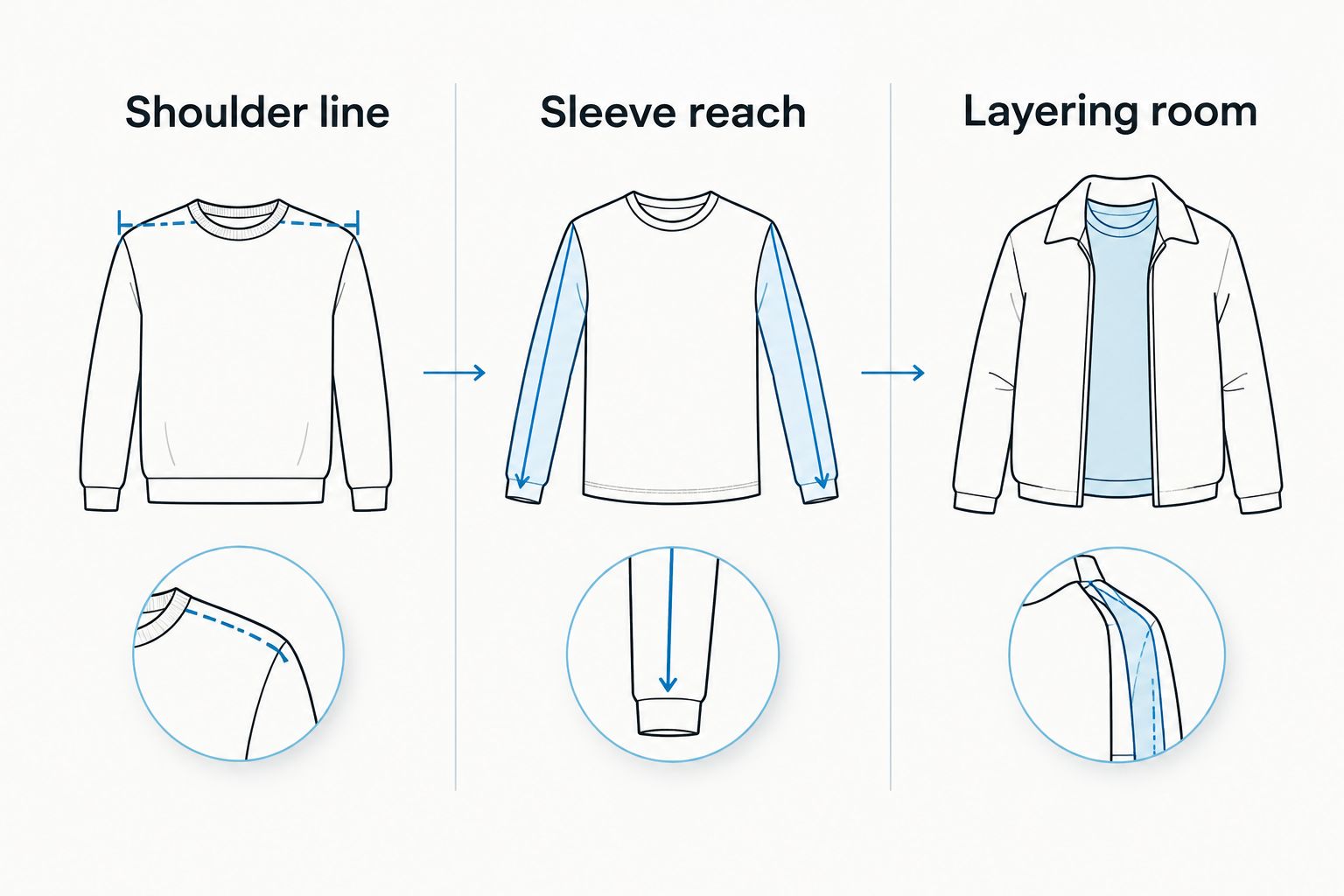
For a closer look at proportions, read how a cotton crewneck sweater should fit. Judge the sweater in an outfit, not only as an isolated garment.
Match the sweater to your everyday routine
A useful alternative should solve a dressing problem. These 3 outfit combinations help you decide whether a cotton crewneck belongs in your rotation without requiring an entirely new wardrobe.
With jeans
Try the sweater with the jeans you wear most often. Check where the hem meets the waistband and whether you prefer it loose or partly tucked.
Use shoes you already own to finish the outfit. If the sweater only feels right after adding several other purchases, reconsider whether it serves your everyday needs.
Over a shirt
A crewneck and a shirt create a layered outfit with a visible collar or cuff. Check that the neckline leaves the collar comfortable and the sleeves do not feel crowded.
Chambray is another shirt option, but it should not be confused with denim. The Chambray’s description identifies 100% cotton in a denim wash and manufacture in India; those details do not make it a denim shirt or establish Portuguese production.
Beneath a coat
Try the full combination before deciding that a sweater works for colder days. Pay attention to the upper arms, underarms and neckline, where multiple layers meet.
For Canadian weather in 2026, choose the complete outfit for the conditions you expect. Do not make a warmth decision from the word cotton, knit or sweater alone.
What manufacturing information actually tells you
One Wednesday’s knitwear description places The Cotton Crewneck’s knitting in Peru. Preserve that wording: knit in Peru is a specific production statement, not evidence that the cotton was grown there, and not a claim that it is Pima cotton.
Apply the same discipline when comparing clothing associated with Turkey, Portugal or China. Country of manufacture alone does not establish better quality, stronger labour protections at a particular workplace or lower environmental impact for a particular garment.
Useful product-level evidence includes:
- Materials: the stated fibre composition and any clearly identified material certification.
- Craftsmanship: construction details you can inspect, rather than assumptions based on geography.
- Traceability: named production stages, locations or makers, with a clear explanation of what each statement covers.
- Working conditions: documented information about the actual production setting, not a country-wide generalisation.
Keep fibre origin, fabric certification and garment manufacture distinct. A statement about certified cotton does not automatically certify every production stage, and a named garment location does not identify every material’s origin.
Use manufacturing information to ask better questions, not to declare one country the winner. That is a more useful standard for a 2026 wardrobe than a country-based quality ranking.
When staying with Oak + Fort is the right call
Keep your Oak + Fort sweater if you like its fit, its care requirements suit your routine and you wear it regularly. An alternative needs to offer something you actually need—not simply a new label.
The same applies to a new purchase. If the particular Oak + Fort garment meets your fibre, fit and layering requirements, there is no reason to reject it because another sweater has a more detailed origin statement.
Best for: shoppers whose chosen Oak + Fort sweater already works with their wardrobe.
Verdict: Hold onto a sweater that earns repeated wear. Skip a replacement that solves no practical problem.
FAQ
What’s the best Oak and Fort knitwear alternative in 2026?
One Wednesday’s The Cotton Crewneck is a focused alternative if you want a sweater described as 100% cotton and knit in Peru by female artisans. Compare its measurements and care instructions with the particular Oak + Fort sweater you are considering before choosing.
Is The Cotton Crewneck better than an Oak + Fort sweater?
The Cotton Crewneck is a better match when its cotton composition, fit and stated production details meet your requirements more closely. That is a product-level decision, not evidence that one brand makes better knitwear overall.
Is The Cotton Crewneck made from Pima cotton?
The product description states 100% cotton, not Pima cotton. Do not treat the stated knitting location in Peru as evidence of a particular cotton variety.
Does knit in Peru mean the cotton was grown in Peru?
No, a knitting location does not establish the fibre’s origin. Fibre production, yarn processing and garment knitting are distinct stages.
Is clothing made in Portugal or Turkey better than clothing made in China?
Country of manufacture alone does not establish better clothing quality or production conditions. Compare the specific garment’s materials, construction, traceability and documented production practices.
Can I wear a cotton crewneck over a chambray shirt?
Yes, a cotton crewneck can be styled over a chambray shirt when the neckline and sleeves accommodate the layer. Check the outfit in motion and beneath your coat rather than choosing by appearance alone.
Should I replace an Oak + Fort sweater I already like?
Keep an Oak + Fort sweater that fits comfortably and earns regular wear. Consider an alternative only when you need a different fibre, fit, layering role or level of production information.
One last thing
Compare every candidate with the sweater you reach for most, not the one you wish you wore. Your favourite already gives you useful evidence about shoulder shape, sleeve length and how much room you prefer.
Before adding another knit to your 2026 wardrobe, put together an outfit with that favourite. Write down the single thing you want the next sweater to do differently. That becomes your buying criterion.

