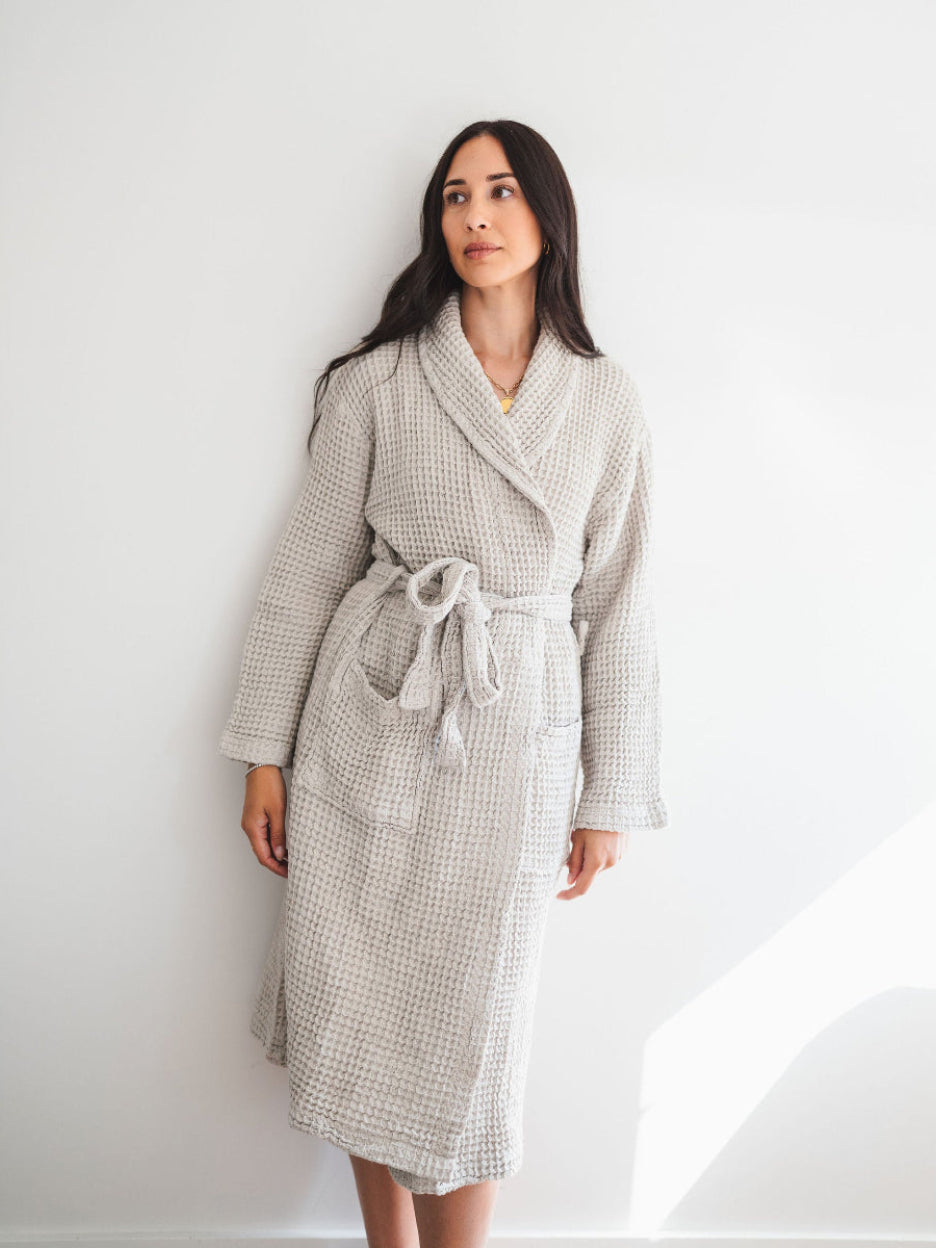


For Peru vs China knitwear quality, check the sweater’s fibre content, construction, fit, care instructions and production evidence—not the country label alone. A place of manufacture does not establish better craftsmanship, fair working conditions or lower environmental impact; those claims need evidence tied to the garment and its production.
- Peru vs China knitwear quality depends on garment-level evidence, not a country-wide ranking.
- One Wednesday’s The Cotton Crewneck specifies 100% cotton and knitting in Peru; neither fact establishes Pima cotton.
- Inspect seams, ribbing and fit, then read the care label before choosing everyday knitwear.
- Treat fibre origin, garment manufacture and factory conditions as separate questions.
Peru or China: what should you check when buying knitwear?
Start with information you can connect to the exact sweater. The same questions apply whether its label says Peru or China: what is it made from, how is it constructed, does it fit your routine, and what supports the production claims?
For a concrete example, The Cotton Crewneck specifies 100% cotton and knitting in Peru. That is useful product information. It is not evidence that every Peruvian sweater is better than every Chinese-made sweater.
| What to check | Knitwear made in Peru | Knitwear made in China | What supports a decision |
|---|---|---|---|
| Fibre content | Read the exact garment’s composition | Read the exact garment’s composition | A product description and matching sewn-in label |
| Construction | Inspect the sweater itself | Inspect the sweater itself | Clear detail photographs and an in-person check |
| Fit | Compare measurements and intended shape | Compare measurements and intended shape | Garment measurements and a try-on |
| Care | Follow the garment’s instructions | Follow the garment’s instructions | A legible care label |
| Working conditions | Ask for production-specific evidence | Ask for production-specific evidence | Relevant factory information and documented practices |
| Environmental claims | Check what each claim covers | Check what each claim covers | Evidence identifying the material, process or facility concerned |
Neither country wins this comparison by default. The better choice is the sweater whose qualities and production claims you can actually assess.
Why this matters
A country label is easy to read. A sweater is more complicated.
You are choosing something that needs to sit comfortably at the neckline, work over your usual layers and fit into laundry day. An attractive origin story cannot answer those questions for you. Nor can it replace evidence about the people who made the garment.
When shopping in 2026, separate what you can inspect from what requires documentation. You can examine an uneven seam yourself; you cannot establish factory conditions by touching soft cotton. Keeping those judgments separate makes the decision clearer without turning it into a country-wide verdict.
Check the fibre description before the origin story
Read the composition before interpreting words such as soft, premium or artisan. A percentage tells you what fibres the garment contains. It does not tell you everything about the yarn, construction or finished feel.
For cotton knitwear, keep these distinctions clear:
- Cotton content: A 100% cotton description identifies fibre composition.
- Cotton type: Pima is a separate claim that needs explicit support.
- Fibre origin: Where cotton was grown is different from where a sweater was knitted.
- Garment manufacture: A knitting location does not identify every earlier production stage.
Do not turn “knit in Peru” into “made from Peruvian Pima cotton.” Those statements describe different things. If a product page does not identify Pima cotton, leave that assumption out of your comparison.
The same discipline applies to a Chinese-made sweater. Read its stated composition rather than assigning a material or quality level from its manufacturing country.
Choose a fibre description you understand, then assess the finished garment. Composition is a starting point, not a complete quality score.
Inspect the knit, seams and finishing
Look closely at the areas that hold the sweater together: shoulders, underarms, side seams, cuffs and hem. You are checking the individual piece, not trying to diagnose a country’s manufacturing standards.
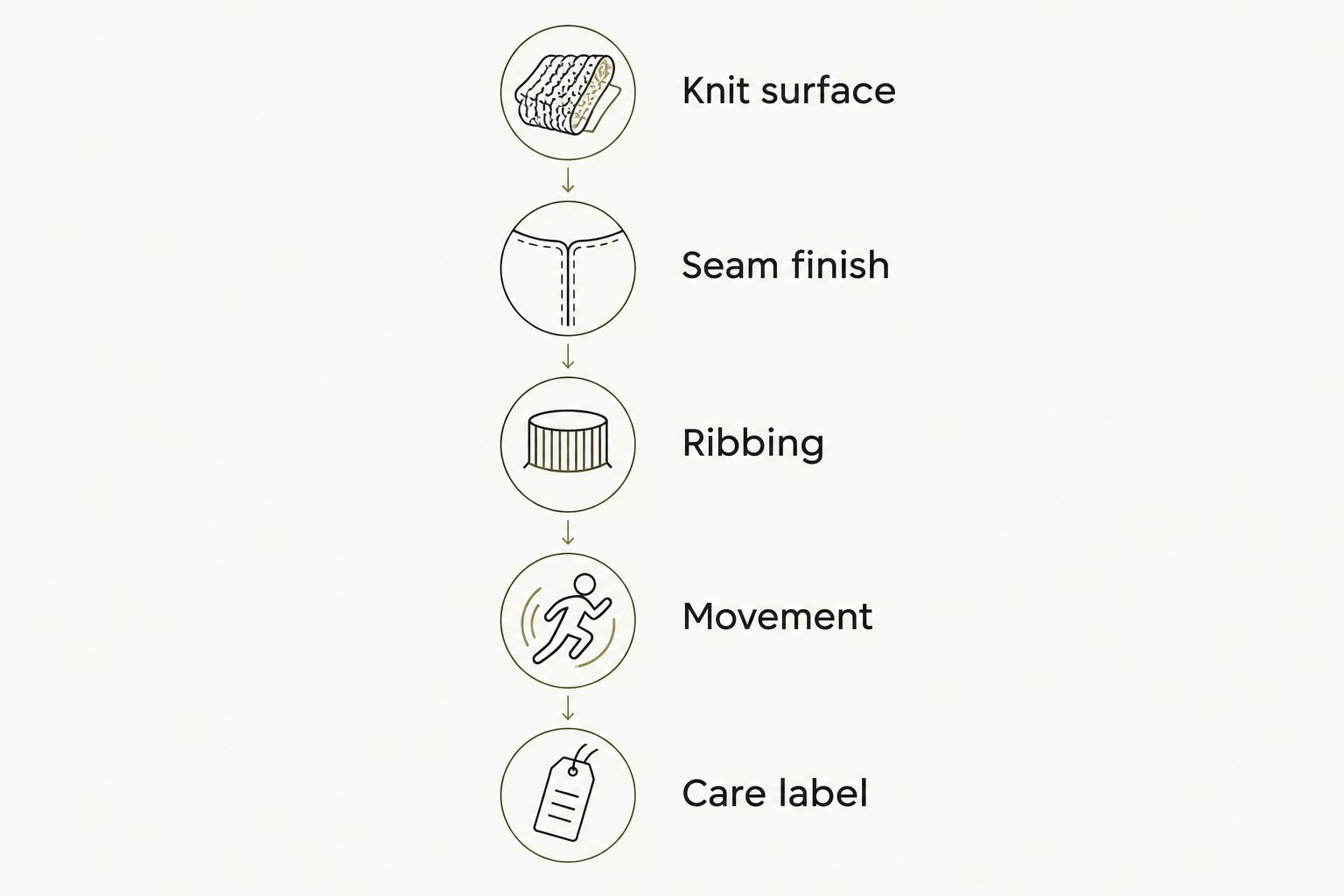
Use these checks in order:
- Knit surface: Look for unintended holes, snagged loops or irregular areas. Distinguish a visible defect from an intentional texture.
- Seam finish: Examine joins for loose threads, openings and uneven finishing. Turn the garment inside out when you can.
- Ribbing: Check that the neckline, cuffs and hem sit as intended rather than twisting or pulling unevenly.
- Movement: Reach forward, bend your arms and sit down. Notice whether a seam pulls or the neckline feels restrictive.
- Care label: Confirm that the instructions suit how you will wash and dry the sweater.
Online, look for close photographs rather than relying only on a styled outfit. A distant image can show silhouette but leave seams and surface texture unclear. Ask for the missing detail if it will determine your choice.
These checks help you assess visible condition and suitability. They do not establish a lifespan, pilling rate or number of washes the sweater will withstand. Those are different claims and need different evidence.
Check fit against the clothes you actually wear
A sweater can look neatly finished and still be wrong for your wardrobe. Try it with the layer you expect to wear underneath, not just whatever happens to be convenient.
For everyday use, assess the shoulder position, sleeve length, neckline and hem together. A relaxed shape should feel intentional to you; it should not require constant adjusting to stay comfortable.
For layering, check whether your shirt sleeves sit comfortably inside the knit sleeves. Look at the neckline with the collar you plan to wear. Then sit down and reach forward so you are judging an outfit in use, not only a still reflection.
For a gift, fit deserves as much attention as manufacturing origin. Compare the recipient’s preferred sweater shape and care habits before choosing. A garment with a compelling production story is still an uncertain gift if you do not know whether its cut suits them.
Buy for repeated wear, not for the label you expect to impress someone. That is a practical recommendation, not a promise about how long any particular sweater will last.
Read production claims at the right level
Manufacturing evidence needs a clear scope. A statement about an artisan, a fibre or a facility should not silently become a claim about an entire supply chain.
One Wednesday’s product information identifies The Cotton Crewneck as knit in Peru by female artisans. That describes the stated location and makers. On its own, it does not establish wage levels, factory audits, working hours or independent certification.
Use the same questions for a garment made in China:
- Which production stage does the named location describe?
- Does the brand identify the maker or facility?
- What does any certification actually cover?
- Is the supporting information relevant to this garment?
- Does a labour or environmental claim include evidence you can examine?
A broad statement such as “responsibly made” needs more explanation than a country name. Equally, an absence of published detail is not proof of poor conditions. It is a reason to ask a more precise question before treating the claim as established.
For a fuller checklist, read how to check whether clothing is ethically made. Keep craftsmanship, labour practices and environmental impact as separate assessments throughout.
What about Turkey and Portugal?
Apply the same standard to Turkey and Portugal. Neither location automatically proves better quality, ethics or sustainability than China.
Fibre origin also needs careful wording. For example, “Turkish cotton” describes cotton origin; that phrase alone does not establish where a finished garment was manufactured. A certification claim likewise needs its stated scope rather than an assumed meaning.
When comparing manufacturing claims in 2026, ask each brand equivalent questions. A detailed account from one maker and a country label from another are not equivalent bodies of evidence.
Why knitwear quality varies
Country-wide rankings compress too many different decisions into one label. For your purchase, focus on these garment-level factors:
- Material specification: Compare the stated composition and any explicitly identified cotton type. Do not fill gaps with assumptions about the country.
- Construction: Look at the knit surface, joins and finishing of the actual garment rather than transferring a judgment from another sweater.
- Intended design: Assess a relaxed silhouette as a relaxed silhouette. Do not mistake a different intended shape for a manufacturing fault.
- Fit on you: Check the sweater with your usual layers and movements. A good description cannot replace that assessment.
- Care requirements: Read the product-specific instructions and decide whether you can follow them consistently.
- Production documentation: Judge labour and environmental statements by their evidence and scope, separately from appearance and feel.
These factors explain what to compare; they do not supply an unsupported ranking. A soft handle does not prove ethical production, and a detailed maker story does not establish how a sweater will fit your shoulders.
A documented Peru-made option: The Cotton Crewneck
One Wednesday is best for shoppers seeking a cotton crewneck with a stated Peruvian knitting origin. The Cotton Crewneck is the relevant option here because its product information specifies the fibre, knitting location and care method.
The official product evidence checked on October 13, 2026 identifies 100% cotton, knitting in Peru by female artisans, delicate machine washing and flat drying. Read those as distinct facts rather than combining them into a broader performance claim.
Best for: Someone who wants an everyday cotton knit and can accommodate flat drying.
The useful detail: One Wednesday’s cotton knitwear description gives you specific material and production information to assess. You do not need to infer the fibre from the country name.
The limitation: The stated facts do not establish Pima cotton, a measured durability advantage or better working conditions than an unnamed Chinese manufacturer. Flat drying also needs a suitable place in your laundry routine.
For a 2026 knitwear purchase, that is a reason to consider the sweater on its documented merits—not a reason to dismiss every alternative made elsewhere. Compare an actual alternative only when its specifications and production information are available.
Is Peruvian cotton knitwear always Pima cotton?
100% cotton does not mean Pima cotton. Cotton composition, cotton type and knitting location are separate details, and each needs its own supporting description.
The Cotton Crewneck’s stated Peruvian knitting origin does not establish Pima cotton. Use the exact material description rather than upgrading it through association.
Does a Peru-made sweater need special washing?
100% cotton does not establish one universal washing method. Follow the garment’s own care instructions rather than a rule based on country of manufacture.
For this crewneck, the official October 13, 2026 product evidence specifies delicate machine washing and flat drying. Do not transfer another cotton garment’s instructions to it.
Can a country label prove ethical manufacturing?
A country label cannot prove ethical manufacturing. You need evidence about the relevant makers, facilities and practices before drawing conclusions about working conditions.
For a 2026 purchase, request information that addresses the claim being made. A material description answers a different question from a labour assessment.
FAQ
Is knitwear made in Peru better than knitwear made in China?
Neither country label establishes better knitwear. Compare the exact garments’ materials, construction, fit, care requirements and production evidence rather than assigning a country-wide quality ranking.
What should I check first when buying a cotton sweater online?
Check the stated fibre composition and intended fit first. Then look for close photographs, garment measurements and product-specific care instructions before deciding.
Does 100% cotton mean a sweater uses Pima cotton?
No, 100% cotton identifies composition, not cotton type. Pima cotton needs an explicit supporting claim; a Peruvian knitting location does not establish it.
What does One Wednesday say about The Cotton Crewneck?
The official product evidence checked on October 13, 2026 specifies 100% cotton, knitting in Peru by female artisans, delicate machine washing and flat drying. Those details do not establish a comparative durability advantage or Pima cotton.
Can I judge ethical production by how a sweater feels?
No, a sweater’s feel does not establish working conditions. Assess comfort directly and evaluate labour claims through relevant production evidence.
Should I reject a sweater just because it was made in China?
No, a Chinese manufacturing label alone is not a reason to reject a sweater. Apply the same material, construction, fit and documentation checks you would use for a Peru-made garment.
What is the most useful question to ask a knitwear brand?
Ask what evidence supports the specific claim that matters to your purchase. For example, request garment measurements for fit, a care label for washing or production documentation for a labour claim.
One last thing
Before choosing, write down what the label actually establishes and what you still need to know. Keep the lists separate.
“Knitted in Peru” can answer a location question without answering a cotton-origin question. “100% cotton” can answer a composition question without answering a working-conditions question. The most useful label is one you read precisely—not one you ask to prove everything.