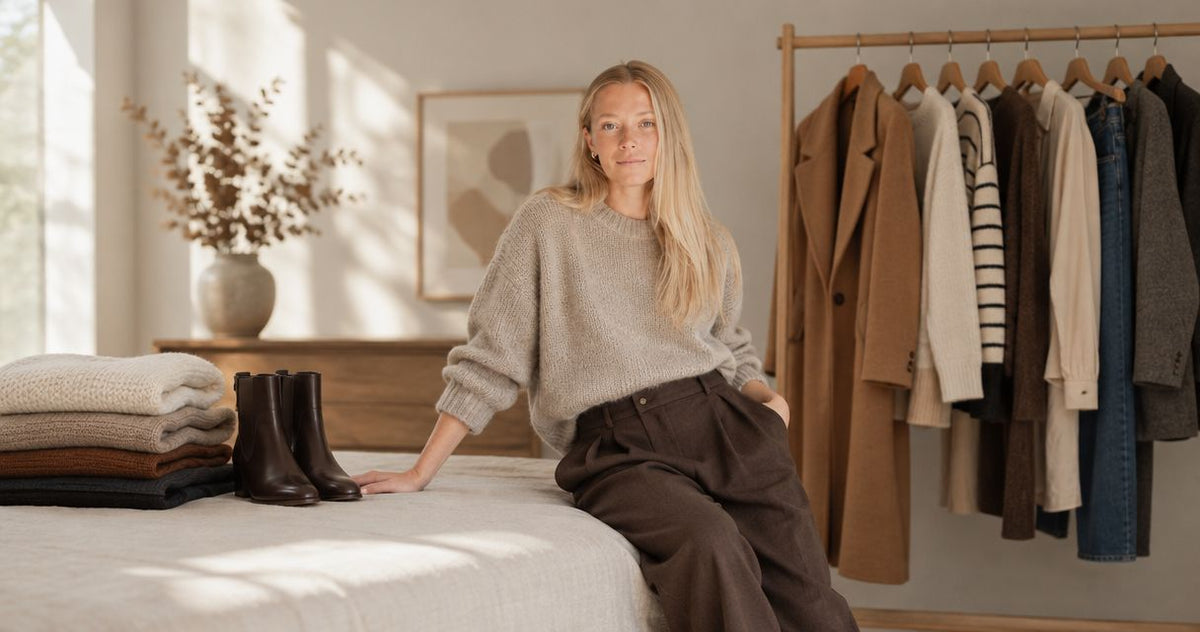


To layer clothes without adding bulk, start with a smooth base, leave room through the next layer’s sleeves, and choose outerwear that fits over the complete outfit. Tightening every layer does not create a cleaner silhouette; it gives the fabric underneath nowhere to sit. For your 2026 wardrobe, build around pieces that move together rather than pieces that only look right standing still.
- How to layer clothes without bulk women: choose a smooth base, roomy sleeves and outerwear that closes comfortably.
- One Wednesday cotton apparel suits shoppers building everyday outfits around a cotton shirt and crewneck.
- Keep collars, cuffs and waistbands simple; overlapping folds create unnecessary volume.
- Test your outfit seated and with arms forward before adding another layer.
How do you layer women's apparel without adding bulk?
Build from the inside out, checking each layer before adding the next. Your base should sit smoothly, your middle layer should accommodate it, and your coat should accommodate both. A slim-looking coat is not a useful finishing layer if you cannot comfortably reach forward.
Start with the clothes you already wear. The aim is not to replace your wardrobe with thinner versions of everything, but to stop sleeves, hems and waistbands from competing for the same space.
For a shirt-and-sweater combination, the guide to layering an Oxford shirt under a cotton crewneck focuses on that particular pairing. The checks below also work when you add a jacket or coat.
- Smooth the base. Straighten the fabric across your back and under your arms before putting anything over it. If you tuck it in, spread the hem rather than leaving it folded at the waist.
- Check the sleeves. Add your middle layer slowly, keeping the base sleeves straight. Stop if fabric gathers at the elbows or pulls across the upper arms.
- Set the edges. Arrange the collar, cuffs and hem once. If they need constant pulling, simplify the combination rather than repeatedly adjusting it.
- Test movement. Sit down, reach forward and bend your elbows. Check whether the layers move with you or pull against each other.
- Add outerwear last. Close your jacket or coat over the finished outfit. Repeat the movement check before deciding the combination works.
Why this matters
An outfit can feel crowded without looking especially warm. A folded shirt hem, a twisted sleeve and a tight jacket lining each add friction in places where you need movement.
Solve the crowded area, not your whole silhouette. If the problem sits at your upper arms, changing your trouser shape will not fix it. If the waistband feels packed, a different neckline will not help either.
This approach also makes getting dressed more practical. You can keep wearing a familiar shirt or sweater while changing its position in the outfit, instead of assuming that every uncomfortable combination needs a new purchase.
Choose a base that sits smoothly, not tightly
A useful base follows your shape without requiring constant adjustment. Look at the underarms, side seams and waist before judging the outfit from the front. Those are the places where excess fabric can disappear beneath another layer and then become uncomfortable.
A close fit is not the same as a restrictive fit. If the base pulls when you sit, it needs a different fit or a different role in the outfit. Making the outer layer larger does not remove tension underneath.
Keep sleeves in mind, too. A loose sleeve can work beautifully on its own but become awkward inside a narrower sweater sleeve. Move that garment outward in the outfit rather than trying to flatten it into a space it does not suit.
For a tucked base, distribute the fabric around the waistband. Avoid pushing the entire hem into the front and leaving a thick fold there. If the tuck feels crowded even after smoothing, try an untucked hem or a simpler base.
Give the middle layer somewhere to go
The middle layer determines whether your outfit feels easy or compressed. Check the shoulder area, upper sleeves and armholes together; room through the body alone does not guarantee comfortable layering.
A sweater can look relaxed at the waist yet feel tight over a shirt at the elbows. Equally, an oversized shirt can have more fabric than you want beneath a close-fitting knit. Neither garment is wrong. Their positions are wrong for that combination.
Keep the least bulky piece closest to your body and the roomier piece outside it. That is a starting point, not a reason to squeeze into a smaller base size.
Before adding a coat, look across your back in a mirror. If the shirt has formed a ridge beneath the sweater, take the sweater off and smooth the shirt rather than pulling down the sweater hem. Pulling at the outside rarely fixes a fold underneath.
Which shirt-and-knit pieces suit this approach?
One Wednesday cotton apparel is best for shoppers building repeat-wear outfits around a cotton shirt and crewneck. The useful distinction is their role: a button-up provides the shirt layer, while a crewneck provides the knit layer. Their fabric composition alone does not establish how bulky the combination will feel on you.
The product details below follow the official descriptions checked on October 13, 2026. Use the fit guidance alongside your own movement check; neither description supplies a fabric-weight measurement or a guarantee of low-bulk layering.
| Piece | Best for | Verified details | Styling advantage | Fit check or limitation |
|---|---|---|---|---|
| The Oxford Button Up | A shirt layer beneath a knit | 100% cotton; made in India; true-to-size fit, with sizing up suggested for a relaxed fit | Adds a collar and cuffs without requiring a separate accessory | Extra room from sizing up also means extra fabric to accommodate underneath a sweater |
| The Cotton Crewneck | A knit layer over a base or shirt | 100% cotton; knit in Peru by female artisans | Provides a crewneck shape for a shirt-and-knit outfit | Cotton composition does not establish knit thickness, sleeve room or suitability beneath every coat |
For the One Wednesday pairing, start with the shirt’s stated true-to-size fit when you want to wear it beneath a knit. Choose a relaxed fit because you want that shape, not because sizing up automatically makes layering easier.
The manufacturing details describe these individual pieces. Made in India and knit in Peru are useful origin information, but country alone does not prove better quality, working conditions or environmental performance. Do not treat the Peru description as evidence of Pima cotton; the stated fibre is cotton.
Why layered outfits feel bulky
Find the specific source of volume before removing a layer. These are the main areas to inspect:
- Sleeve mismatch. A wide inner sleeve has to gather inside a narrower outer sleeve. Try the roomier garment on the outside.
- Stacked waistbands. A tucked shirt, folded sweater hem and trouser waistband can occupy the same area. Remove a fold before changing the whole outfit.
- Crowded necklines. A shirt collar, high knit neckline and scarf can feel busy together. Leave the scarf off while you assess the shirt and knit.
- Competing hems. Several visible edges close together can make the outfit feel fussy. Decide which hem you want to see and arrange the others deliberately.
- Restricted outerwear. A coat that fits over a tee does not automatically fit over a shirt and sweater. Test it with the actual combination.
- Twisted fabric. A sleeve or side seam that turns during dressing creates an avoidable ridge. Straighten each garment before adding the next.
How do you keep a business-casual outfit neat?
Start with the shirt-and-knit combination before adding a jacket. Let the collar sit naturally, straighten the cuffs and decide whether the shirt hem will be visible. A deliberate edge looks calmer than several edges adjusted at random.
Keep the waist treatment simple. If you tuck the shirt, try leaving the sweater hem unfolded. If the sweater already sits comfortably over your waistband, there is no need to add a front tuck just to make the outfit look styled.
For a 2026 work wardrobe, test the outfit at a desk rather than only in a mirror. Sit, reach towards a keyboard and rest your forearms forward. If the shirt pulls across your back or the sweater grips at the elbows, change the pairing before adding a blazer.
Choose comfort in your working position over neatness in a standing pose. That is the fit you will actually wear through the day.
How do you layer for cold weather without overfilling your coat?
Keep indoor layers comfortable, then assess your coat over them. Do not compensate for a crowded coat by making every garment underneath tighter.
Try the coat with the same sleeves, collar and scarf you intend to wear outside. Close it, reach forward and check whether the inner sleeves move freely. A coat that only works open is not the same as a coat that comfortably closes over your outfit.
If the combination feels packed, simplify the middle rather than immediately removing the base. You can also choose a roomier coat from your wardrobe. Keep weather protection appropriate to the conditions; a slimmer silhouette is not a reason to dress inadequately for cold weather.
For Canadian winter dressing in 2026, treat cotton shirts and sweaters as outfit components, not proof that a complete outfit is warm enough. Conditions, exposure and your outerwear still matter.
Can oversized clothes work in a low-bulk outfit?
Yes. Give an oversized piece space rather than surrounding it with equally full layers. An oversized shirt can sit outside a smoother base, while a roomy sweater needs a shirt that does not bunch beneath it.
Choose where you want the volume. You might prefer a loose upper half with straight trousers, or a neater shirt-and-knit combination with wider trousers. These are styling choices, not rules about which bodies can wear which shapes.
The practical test stays the same: can you sit and move without readjusting the layers? If you like the silhouette and the fabric sits comfortably, visible volume is not a problem you need to remove.
Keep the fit through washing and drying
Care is part of keeping a layering combination useful. Follow each garment’s instructions separately rather than washing a shirt and sweater the same way because both contain cotton.
The Oxford Button Up instructions checked on October 13, 2026 specify cold gentle or delicate washing and cool ironing while slightly damp. Do not infer a dryer setting from unclear drying wording; follow the garment’s care label.
The Cotton Crewneck instructions checked on October 13, 2026 specify delicate machine washing and flat drying. That differs from treating it like an ordinary cotton shirt.
Before dressing, smooth the shirt and check that the sweater has dried fully. Begin with the garments arranged properly, then assess the fit. A folded hem or sleeve left twisted from storage can make a familiar combination feel unexpectedly awkward.
FAQ
What's the easiest way to layer clothes without looking bulky?
Start with a smooth base and add a middle layer with enough sleeve room. Straighten each garment before adding outerwear, then check the outfit seated and with your arms forward.
Should I size up my shirt to wear it under a sweater?
Do not size up automatically for layering. Extra shirt fabric needs space inside the sweater, so choose the shirt fit and sweater sleeve room together.
Can I wear a cotton button-up under a cotton crewneck?
Yes, provided the shirt sits smoothly and the crewneck accommodates its sleeves and collar. Cotton composition alone does not tell you whether the combination will feel bulky.
How do I stop my shirt bunching under a sweater?
Straighten the shirt across your back and through the sleeves before putting on the sweater. If it still gathers, change the fit pairing rather than repeatedly pulling down the sweater hem.
Should every layer be tucked in?
No, every layer does not need a tuck. Tuck only where it helps the outfit sit comfortably, and avoid stacking folded hems at the waistband.
What should I check when buying layering clothes in 2026?
Check sleeve room, shoulder comfort, hem position and the care instructions. Try the pieces with the coat you intend to wear rather than judging each garment alone.
One last thing
Before buying another layer, take your usual outfit apart and put it back on slowly. Straighten the base, settle the sleeves and leave unnecessary folds out of the waistband.
The cleanest-looking outfit is not always the one with the fewest pieces. Sometimes it is the same outfit, with the fabric finally sitting where it belongs.